


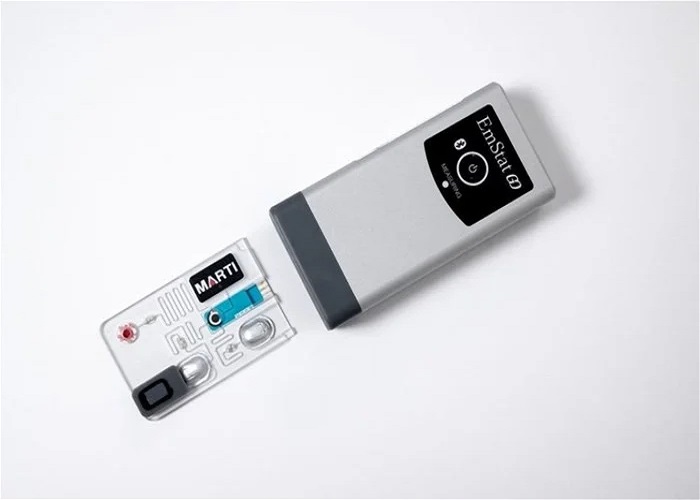
University of Pretoria researchers have designed a small but powerful handheld device that may redefine the TB screening process and ultimately help to combat the TB pandemic more effectively, reports BizCommunity.
The device, called MARTI (mycolate antibody real-time immunoassay), can provide very high certainty that a person at risk does not have TB, said the team
Using just one drop of blood – and no laboratory – it may change how TB is detected, and even be adapted for use in both human and veterinary healthcare, being fast, accurate, affordable and proudly South African.
An internal validation trial was recently completed to confirm the test’s accuracy, the results showing remarkable promise and coming close to the range of targets set by the WHO for the “perfect” test.
An earlier trial demonstrated great potential in using this test to monitor TB treatment: these results were published in the journal Biomarkers in Medicine.
“Many people aren’t aware that TB doesn’t always sit in the lungs – it can be present in bones, joints and the brain,” said Professor Jan Verschoor, former research leader of UP’s Tuberculosis Research Group in the Department of Biochemistry, Genetics and Microbiology and now an emeritus Professor of Biochemistry who has been leading this discovery.
“The ‘gold standard’ TB test that involves growing cultures from lung sputum can take about six weeks, by which time, many more people could have been infected by the patient, or the patient’s health could have deteriorated beyond the prospect of cure.
“From a simple finger-prick blood sample, the MARTI test gives us a result in 30 minutes. This has profound cost and public health implications in a country like South Africa, where we conduct three to five million TB tests a year.”
Caused by Mycobacterium tuberculosis, this resilient bacterium has long evaded simple detection methods, particularly in regions where healthcare infrastructure is limited. But now, an unexpected hero has emerged in the war on TB: a molecule in the bacterium’s waxy coat – specifically its mycolic acid (MA) – holds the key.
These wax-like substances form a nearly impenetrable barrier, making the bacterium both drug-resistant and difficult to detect.
But while other scientists focused on breaking through this barrier, Verschoor took a different approach: what if the wax itself could be used to detect the disease? He was the first to demonstrate that antibodies to the waxes are reliable indicators of active TB, irrespective of whether someone had been vaccinated or was co-infected with HIV.
A key aspect of the innovation came from Carl Baumeister, a PhD candidate under Verschoor. He made the leap from slow laboratory-based biosensing to a handheld device that detects anti-MA antibodies accurately and affordably in less than 30 minutes.
The result is a test that’s as clever as it is simple and cost-effective.
Detecting these anti-MA antibodies requires sophisticated sensing technology: the surface of a screen-printed carbon electrode is pre-coated with a thin layer of MA. MARTI works by flowing a drop of blood over this electrode.
If a patient has TB, the sensor detects these antibodies in the blood sample; if a patient does not have TB, no signal would be generated since there are no anti-MA antibodies in the blood sample.
“The device fits in the palm of your hand and requires only a single drop of blood – no sputum, no needles, no laboratory,” said Baumeister, head of operations of the UP spin-off company MARTI TB Diagnostics.
“This may become a game-changer to diagnose TB in paediatric and HIV-positive patients, where obtaining sputum samples is often neither feasible nor safe. The same could apply to the 20% of all extra-pulmonary cases.
“If MARTI says you don’t have TB, you can trust it,” Baumeister added. “That’s a critical trait when trying to rule out cases during an outbreak or in mass screening campaigns, much like what was needed during the Covid-19 pandemic.”
Unlike other TB diagnostics, MARTI offers something rare and powerful: near-perfect negative predictive value in typical screening applications.
The internal validation trial across six healthcare facilities in Tshwane was led by Prof Veronica Ueckermann, Head of Infectious Diseases at Steve Biko Academic Hospital and UP’s Faculty of Health Sciences.
“Collecting, transporting, processing and analysing the samples from the various sites within the temperature and time constraints of the validation trial protocol posed a significant logistical challenge, but we succeeded,” said Mosa Molatseli, a senior research scientist who heads up the MARTI laboratory.
Recognising its potential, UP established the start-up company MARTI TB Diagnostics (Pty) Ltd to develop and eventually commercialise MARTI.
“This is designed to ensure the technology remains in South African hands while attracting investment and serving global needs,” said Gerrie Mostert, interim CEO of the company.
“The next steps are to get investors, funding and partner organisations on board, obtain regulatory approval and start manufacturing the kit. Ultimately, MARTI should be rolled out to clinics worldwide.”
See more from MedicalBrief archives:
Newly available tests for rapid TB diagnosis: what you need to know
SA to expedite TB diagnosis/treatment as cases continue to soar
More than half of South Africans do not seek TB treatment – HSRC survey