


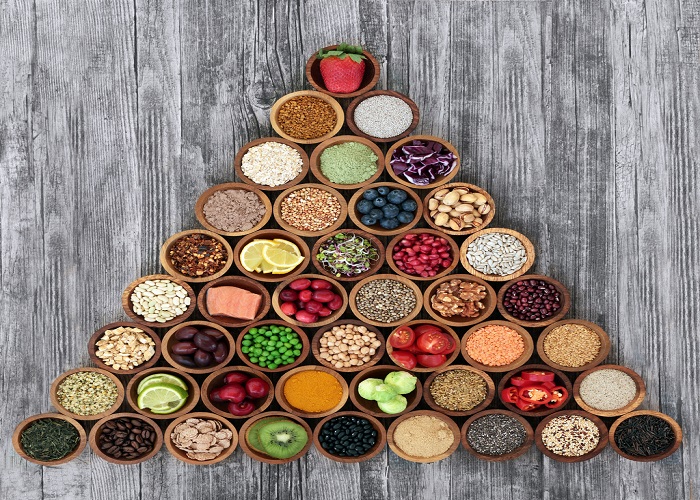
A new, first-of-its-kind international food pyramid has recently been designed to reflect scientific agreement across multiple countries and cultures, reports Healthline.
Developed by 22 nutritionists from Europe, Canada, the United States and Australia, and highlighting plant-based protein sources, cooking with plant-based oils, and healthier sugars and carbohydrates, it was published in Advances in Nutrition.
The new pyramid breaks away from America’s recently updated nutritional guidelines – which prioritise red meat over plants – and designed by a research team led by Brigham Young University Professor Karen Della Corte, it echoes the traditional food pyramid used in the United States since 1992.
For the project, Corte and researchers from the International Carbohydrate Quality Consortium (ICQC), compared dietary guidelines from multiple countries, including: Canada, Germany, Australia, the US, China, The Netherlands, and Nordic countries.
They also analysed evidence from more than 250 scientific publications, while drawing on the EAT-Lancet Planetary Health Diet to identify principles of healthy eating that may be shared.
The new pyramid highlights three guidelines:
Plant foods as the foundation: make vegetables, fruits, whole grains, and legumes the base of your healthy diet.
Choose healthier fats and proteins: opting for unsaturated plant oils (olive, canola) over saturated fats (butter, tallow), and poultry, fish, and legumes over red and processed meats.
Prioritise carbohydrate quality over quantity: consider factors like fibre content, processing level, and glycemic index, rather than focusing solely on the total grams of carbohydrates.
Although the pyramid emphasises plant-based proteins, it doesn’t exclude animal proteins.
How it compares with US dietary guidelines
Both sets of guidelines discourage added sugars, refined carbs and highly processed snacks.
The differences between the two mainly lie in their emphasis on specific sources of protein and fat. For example, the new pyramid prioritises plant-based proteins, while the US guidelines place more emphasis on animal proteins, including red meat.
Also, while both sets of recommendations advise limiting saturated fat, the new pyramid emphasises unsaturated plant oils, whereas US guidelines also include butter and beef tallow as cooking fat options.
An important distinction is that this new pyramid goes beyond simply telling people to eat more protein or fewer carbohydrates. Instead, it encourages people to consider the quality and sources of those nutrients.
Study details
Toward International Dietary Guidance: A Food Guide Pyramid for Human and Planetary Health
Karen A Della Corte, Anette Buyken, Carlo La Vecchia et al.
Published in Advances in Nutrition on 23 September 2026
Abstract
Dietary guidelines shape food policy, education, and food systems worldwide. Recent controversies in dietary guideline development, together with rising burdens of diet-related chronic disease and increasing environmental pressures, highlight the need for globally relevant dietary guidance aligned with both human and planetary health. We developed an evidence-informed International Food Guide Pyramid emphasising optimal carbohydrate-containing staple foods. The International Carbohydrate Quality Consortium developed the proposed framework using a 4-step evidence-review process involving comparison of major national and regional dietary guideline systems, integration of evidence syntheses and selected primary studies, and expert consensus. Quantitative intake ranges from the EAT–Lancet Commission reference diet informed the relative visual proportions of food groups, whereas the guiding principles were derived from convergence across dietary guideline systems and complementary evidence syntheses. The resulting pyramid depicts a plant-forward omnivorous dietary pattern supported by epidemiological and clinical evidence indicating benefits for cardiometabolic health and chronic disease prevention. Vegetables, fruits, whole grains, and legumes constitute foundational components of the pyramid. Nuts, seeds, and unsaturated plant oils are emphasised as primary fat sources, whereas foods high in saturated fat are generally limited. Animal-source foods are included in modest amounts, with plant protein sources emphasised, poultry and fish preferred over red meat, and dairy incorporated in modest amounts, consistent with dietary patterns associated with lower environmental impacts. Carbohydrate quality is emphasised through the prioritisation of whole-grain foods alongside traditional low-glycemic index grain staples, favouring carbohydrate sources rich in dietary fibre, intact plant cells, and micronutrients while limiting sugars consumed in low-nutrient forms, particularly sugar-sweetened beverages. The framework also accommodates vegan and other primarily plant-based dietary patterns. This evidence-informed International Food Guide Pyramid integrates quantitative modelling and qualitative evidence synthesis to provide a coherent, flexible, and globally adaptable dietary framework aligned with both human and planetary health.
Healthline article – New Food Pyramid Puts Healthy Carbs and Plant-Based Foods First (Open access)
See more from MedicalBrief archives:
Controversial review finds that cutting back on red and processed meat has little health impact
Plant-based diets can miss key nutrients – Dutch study
The Longevity Diet: How nutrition affects ageing and healthy lifespan – US analysis