


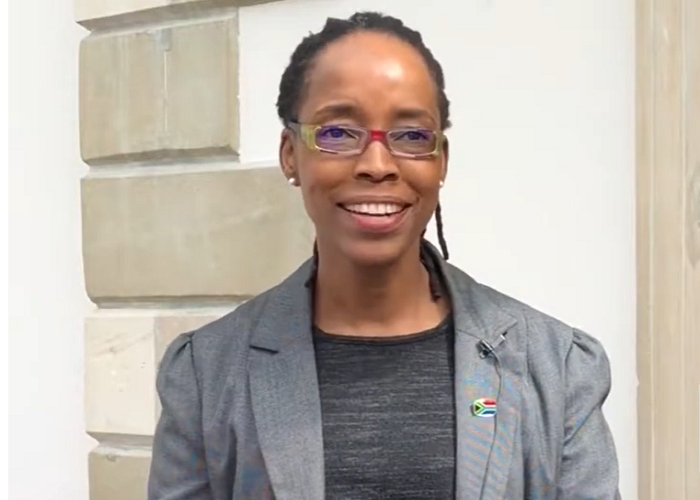
A breast cancer diagnosis and the illnesses that followed transformed Kwanele Asante into one of Africa’s most prominent voices for people living with non-communicable diseases (NCDs) and mental health conditions.
Last year, writes Sean Christie for Bhekisisa, the South African lawyer and bioethicist stood before the UN General Assembly to deliver a lived-experience addresson the issues, the culmination of two decades spent insisting that health systems listen to the people their policies are meant to serve.
But when she returned home from that journey in September 2025, a wave of new health challenges washed over her, forcing a step back from activism.
Born in a Soweto TB sanatorium where her parents met, Asante moved through six schools and a Bantustan education delivered by army conscripts, through university in the United States, a law degree at Wits and, finally, a degree in bioethics.
It was the breast cancer diagnosis at 37 that transformed her into an activist, later founding BreastSens on the lessons of South Africa’s HIV response and walking away from the “pink ribbons”, critical of a global health system that speaks for communities it barely knows.
Changes and flux
“In February, Google AI referred to me as ‘the late Kwanele Asante’ — almost like a premonition,” says Asante, who a few weeks later developed abdominal pain in her right side and was urgently admitted for surgery to remove an inflamed appendix.
“Then all these other things started happening. When I was finally discharged 19 days later it was April, the month of my diagnosis with breast cancer 20 years ago.”
Asante, who has always rejected the designation “breast cancer survivor”, talks about her health in an all-encompassing way, to make a larger point: people don’t necessarily experience the health system as a series of separate diseases and specialist programmes.
“I am in chronic treatment for chemotherapy-induced congestive heart failure, bipolar mood disorder, anxiety and now functional neurological disorder, meaning the brain software is not functioning properly. The cancer survivor label doesn’t quite cover it,” she says.
Even in name, Asante refuses to remain static. She was born Anne Molebatsi Pooe but called herself Molebatsi Anne Pooe at university, and later Molebatsi Pooe-Shongwe, before legally changing her name to Kwanele Asante-Shongwe in 2012 (although she mostly goes by Kwanele Asante in her professional life).
Every change has been a waymarker in a life that began in the TB sanatorium in Soweto.
“My mother and father met in Charles Hurwitz (TB hospital), probably in the canteen from that famous Ephraim Ngatane painting. I was reflecting the other day that my entire life has been defined by healthcare,” says Asante, who was born in Meadowlands in 1969.
Her father, Aaron Sonnyboy Pooe, and mother, Lerato Nokoane (born Dikeledi Lydia Nokoane), were divorced before Asante turned five. She and her younger brother Lesele never saw their father again.
She describes her mother as “a very tenacious woman”.
“My father was her second husband: she had six children before my brother and I. We were very poor, and after our father left she took a job teaching at Batswana Teacher’s Training (BAT) College in Mafeking (now Mahikeng), later becoming a live-in boarding master to supplement her salary.”
It was a solution that held until the 1976 Soweto Uprising.
“We were kicked out of our little room because the kids felt we were leeching off them,” recalls Asante, who was in grade one at the time, at Diphetogo Primary School.
“It was a difficult time because mum was reinventing – she went away to Baviaanspoort (Zonderwater Prison and Training College near Tshwane) for six months to train as a prison officer, leaving us with a relative we had only met the day before she left.”
Asante says she wasn’t coping at school.
“One teacher used to split the class into ‘smart ones’ and ‘donkeys’. I was in the donkey group. I was unhappy. Then I met a woman who saved my life.”
Dineo Mpofu, a teacher at Diphetogo, saw something in the struggling seven-year-old.
“She said, ‘You are actually smart. Come to me during break and we will work on your cursive writing’. She was by my side until standard four, by which time I was a very strong student,” says Asante, who moved across to the new middle school that had been established at BAT.
The Bantustans
In the early 1980s Mafeking had just been incorporated into the recently proclaimed Republic of Bophuthatswana. To combat liberation ideologies in the Bantustans, the South African Defence Force had started sending conscripts with university degrees and teaching diplomas to teach in certain Bantustan schools, including the new Batswana high and middle schools. And so Asante’s teachers were mostly white servicemen.
“They saw it as a way of winning hearts and minds. We saw it as a sneaky way of getting a kind of private school education,” Asante recalls.
There were some civilian teachers, too, and Asante remembers one man with particular fondness — Denzil Fincham, her standard five English teacher, who later became headmaster of Kingswood College in Makhanda.
“He would say, ‘Anne, stand up, give us an unprepared speech. You need to learn to speak properly because you’re going to be an important person one day.’ At first I thought, ‘Oh no! He is really irritating me,’ but it was actually formative,” says Asante, whose polished elocution saw her through door after door later in life.
Before her world cracked open, however, it was unusually cloistered.
“Mum took a job at Rooigrond Maximum Security Prison where we lived for years, on this prison base in the middle of nowhere, surrounded by prisoners.”
The prison provided a form of stability, which ended when her mother transferred to Odi prison in Mabopane, north of Pretoria (she was later reposted to Rooigrond, and appointed inspector of prisons for the Republic of Bophuthatswana).
“I had attended six schools by matric. It was very destabilising,” says Asante, who was taken in hand by the principal of Pelotona Middle School in Mabopane, ZK Mogodiri.
“He was a pan-Africanist, who at assembly would say, ‘African child, we are not going to be doormats of other nations’. He was strict but took a liking to me, and when he realised that we were about to move again he drove a hundred kilometres to Motswedi in Zeerust to find me a place at the boarding school there,” says Asante, who matriculated in 1987.
The next Easter she met Isaac Shongwe, whose family paid lobola for Asante in 1989.
Shongwe – today a prominent South African business personality – had just graduated from Wesleyan University in the US, and suggested Asante might want to apply.
“I had been fascinated with America for most of my life. I needed no urging. We moved abroad in August 1989.”
Like her husband before her, Asante received a full scholarship. She studied sociology and psychology, and felt very at home in Wesleyan’s vocal liberal arts culture.
From Anne to Molebatsi
“People would ask, ‘You’re African, yet your name is Anne. How?’ and so I switched it around, and became Molebatsi Anne.”
Shongwe, by now a Rhodes Scholar, was at Oxford, and so the two travelled between England and America, with a trip home in 1991 for the birth of their first child, Sibusiso Mandla Shongwe, today a well-known film director and multimedia artist.
Their second child, Mbali-Pfeiffer Shongwe (a notable young mental health advocate and gender-based violence activist), was born in 1999.
After graduating in 1994 Asante returned to South Africa for good. Her memories of the job market have her smiling.
“It was when everybody was looking for a black. The moment you accepted a role, others would be knocking, looking to poach.”
From Pretoria Portland Cement, where Asante worked as an internal communications co-ordinator, she was employed by FNB as a group journalist, writing articles and booklets (including one on breast cancer) for the bank’s 36 000 employees, before being lured to Anglovaal Minerals (since incorporated into African Rainbow Minerals) to oversee their internal communications.
She witnessed first-hand the toll HIV was taking on mineworkers, and became frustrated with management’s apparent reluctance to “walk the talk” of safer sex practices in their own lives and professional spaces.
“There were no condoms in the head office or mining office bathrooms, even though it was well known that many of the metallurgists, geologists and mining engineers, 95% of whom were white, practised unsafe sex.”
Faced with this hypocrisy, and seeing the sector’s stark social inequality on her daily commute to work, she felt increasingly conflicted about her high salary.
“I’m not sure that any of the corporations I worked for actually had a job for me, and that’s a heavy suspicion to live with, especially when you see things happening that you don’t agree with,” says Asante, who often complained to family friend (and former Constitutional Court judge) Edwin Cameron about her ethical conundrums.
“One day he said, ‘Listen, when I first met you at 19, you said you wanted to become a lawyer. I think you’re a natural born lawyer. Go to law school’.”
Asante was 32. She thought about it, and remembered her mother’s uncle, the writer JB Leseyane (author of the classic Setswana novel Monageng), who lived in a village in Swartruggens. She, her brother and their cousins all called him Ntatemogolo (grandfather), and visited often.
“He would invite me to these kgotlas (traditional court sessions) under a tree, where people could come and report their issues — how somebody stole somebody else’s cow, or beat their wife, and so on — and I would be the only child, but he kept taking me, until he was murdered when I was 10. Now, I realise this was my introduction to law.”
Asante tool Cameron’s advice, enrolling for an LLB at Wits University, and afterwards joining Deneys Reitz to do her articles.
“I hated it,” she says.
‘No health without mental health’
“Candidate attorneys were basically messengers, serving summonses and doing pagination. I was 35, from a campus activist background. I had worked three corporate jobs. I was like, ‘Guys, I’m not here to photocopy.’ I was a difficult candidate attorney, and in fact the experience just worsened from one rotation to the next.”
Asante had one champion during this lonely period, an institutional aviation law specialist called Pierre Naude, who treated her as a colleague, taking her to crash sites and commending her written opinions. When she was not retained as an attorney after her two years’ candidature he walked across to her office.
“He closed the door, and said, ‘You’re a very good lawyer – don’t let this make you forget that. I know that you love human rights, perhaps your future lies in this direction.’ He wrote me the most beautiful letter of recommendation as a lawyer and a thinker.”
Three months later, at 37, Asante was diagnosed with breast cancer.
“The lump had been in my breast for some time, and I knew from that booklet I wrote for FNB that it was more than likely a problem, but I was just hoping it would miraculously disappear.”
A breast biopsy confirmed breast cancer.
“Suddenly, I was a very sick woman. I found my heart would be palpitating after chemo sessions, but when I reported this to my oncologist, he was dismissive.”
She read on the website of the American Society of Clinical Oncology that some of the chemotherapy medicines can cause heart damage, and immediately called her GP, who had a cardiologist meet her in a nearby emergency room.
“The cardiologist greeted me with, ‘I believe you are a Google self-diagnosed patient’, but the moment he listened to my heart he shouted, ‘Code Blue!’ and people descended on me.”
It was discovered that Asante had chemotherapy-induced cardiomyopathy, a disorder of the heart muscle. Three years later, during a routine check-up (and shortly after her divorce from Shongwe), her cardiologist told her she was at imminent risk of a fatal heart attack.
“He said I needed a machine implanted under my skin – an implantable cardioverter defibrillator, which detects irregular heartbeats and gives an electric shock to restore it to normal. I had the procedure, and when the bill came and I saw how much it had cost, I cried and cried. My medical aid had covered it. All I could say was, ‘Kwanele, Baba. Asante.’ Kwanele is isiZulu for ‘it is sufficient’. Asante is Kiswahili for ‘thank you’.”
In 2012, Asante formalised her gratitude by taking these words as her legal name, or what she calls her “healing name”. Her experience had left her with troubling questions, however.
A health rights approach to breast cancer
“In the Sandton Oncology Centre I was struck by how few black women there were in the waiting room. I only saw two the whole time, and they were from Botswana. I asked my cardiologist, ‘Am I the first black woman to have breast cancer?’ and he said, ‘No, there are many. Most go to Helen Joseph, Charlotte Maxeke and Chris Hani Baragwanath Hospitals. Some come here, but they come at odd hours because they don’t want people to know’.”
Asante decided to find out for herself.
“I visited Bara and there were about 30 women in a little room, all half-naked from the waist up with decaying breasts. It was before they had the breast clinic, and there were no gowns. It was a mess.”
Asante confronted the surgeons, one of whom countered that the patients were all women (so why would they mind?).
“I said, ‘Would Gogo traditionally be sitting like this with a woman half her age?’ and he got it. The next week – because the clinic was only held on Wednesdays then – everyone had gowns. My friends in the northern suburbs and I pooled together to buy some things but that doctor bought the first 20 gowns himself.”
Out of this experience came BreastSens, the NGO Asante founded to promote health rights, human rights and breast cancer education among indigent women in Soweto.
“It was nothing new, I simply copied Edwin and others’ work on treatment access for people with HIV, and transposed it to breast cancer.”
She says her legal training proved invaluable (she never did work as a lawyer) although she acknowledges that it, and her relative privilege, were also barriers needing to be overcome.
“I was coming at it with the self-importance of an activist lawyer. The women who let me into their lives were my saving grace. I spent six years working in Soweto’s communities. I met the families, and came to know their realities. Three of the women I knew developed cardiotoxicity like I had, and died. They didn’t get defibrillators, like I did. They died, and they were all remarkable, single mothers of young children. They all died at 35. At that time, I was 44.”
Off pink
Asante says she did join the “pink ribbons” for a time – the established network of breast cancer advocacy organisations – “but quickly understood what they were: the commodification of a woman’s disease by marketing companies. So I stopped wearing the pink outfits.”
She was nominated by Soweto communities to join the inaugural ministerial advisory committee on the prevention and control of cancer, of which she was later elected deputy chairperson. She then served a second term, chairing the committee. In parallel, she decided to study again.
“I was often the loudest ‘lived-experience’ person in the room at the conferences I was attending at home, on the continent and abroad, and cancer researchers and cancer doctors would say, ‘What’s this lawyer doing in medicine?’ A very dear and faithful mentor and friend (retired academic and education champion Gillian Godsell) advised me to do a master’s degree with the word medicine in it, so I enrolled for an MSc in bioethics and health law, health and human rights at Wits’ Steve Biko Centre for Bioethics,” says Asante, who was asked to stay on and lecture upon graduating in 2016.
“I loved my students but only lasted one year because teaching is very exhausting, and little paid.”
Asante returned to patient advocacy, deepening her commitment to the African Organisation for Research and Training in Cancer, with which she had been involved for some years, eventually serving as the secretary general in 2020.
That year she became a member of the WHO’s civil society working group on NCDs. She became a fierce critic of the global health advocacy system she had joined. In a 2025 BMJ article, for example, she and her co-authors argued that global NGOs and health organisations are often guilty of advocating for patients, families and communities in generic and potentially extractive ways, while remaining stubbornly headquartered in Europe or North America.
She travelled back and forth from Geneva, but at some point experienced a crisis of conviction.
“I found I was reacting to these white women doing their higher degrees in global health and development, who would come and say” – and here Asante affects an American accent with extraordinary disdain – ‘I’m here to talk on behalf of my community in Ndola, or Lusikisiki’ – and I’m sitting there thinking, ‘your community?’
“Yet after I had reacted that way three or four times over the years, I thought, ‘Actually, who appointed you [Kwanele Asante] a spokesperson for black women? How well do you know your community?’ I was born in Soweto, but … hmm.”
It’s a fittingly self-aware and self-questioning ending to our conversation about her protean life, a life that I suspect (based on her grumbling about private medical aid billing practices, after her recent hospital stay) has strident activism in it yet.
See more from MedicalBrief archives:
SA failing to meet palliative care needs, conference hears
Johannesburg protest march over neglect of cancer patients
NCDs now killing more South Africans than TB in major public health shift