


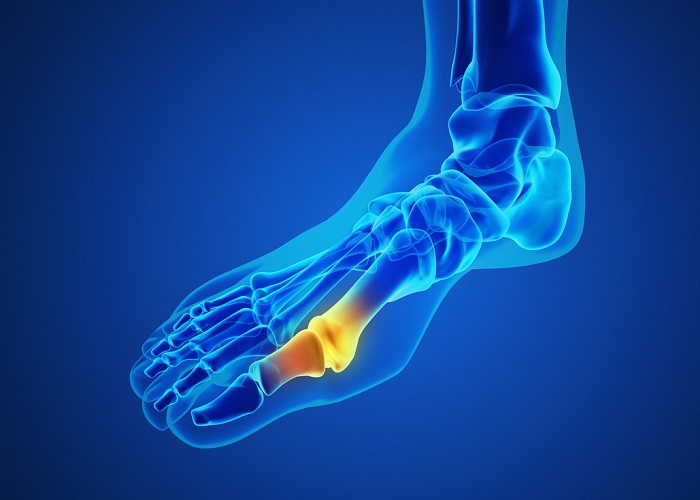
Results of a recent randomised trial found that surgery was better than “watchful waiting” or letting nature taking its course when it comes to painful osteoarthritis of the first metatarsophalangeal joint (MTPJ) – aka the big toe, reports MedPage Today.
Among 90 patients randomised to arthrodesis (joint fusion) or the “watchful waiting” option, pain scores with walking were reduced after one year from a baseline mean of about 6 on the standard 0-10 scale to an average of 1.3 in the intervention group compared with 5.7 among controls, found Mikko Miettinen, MD, of Helsinki University Hospital in Finland, and colleagues.
That translated to a mean adjusted difference of 5.0 points, which was both statistically significant (95% CI 3.9-6.1) and far greater than the prespecified margin of 1.7 points for clinical significance, the researchers reported in Annals of Internal Medicine.
Most secondary outcomes also favoured surgery.
Although arthrodesis is the most common surgical remedy for the condition, also called hallux rigidus, it had never before been tested in a randomised controlled trial against non-surgical or no treatment, Miettinen and colleagues noted.
“Our finding that first MTPJ arthrodesis produced a clinically meaningful reduction in walking-related pain and other important clinical outcomes compared with watchful waiting has considerable clinical importance,” they wrote.
They recommended it be considered an important treatment option for people aged 40 or older with pain and disability from hallux rigidus for one year or more.
Typically, treatment for hallux rigidus begins with over-the-counter painkillers, orthotics, and “activity modifications”, although their effectiveness hasn’t been rigorously tested either.
“Various surgical procedures may be performed when symptoms worsen, but arthrodesis is widely regarded as the gold standard … particularly in advanced disease,” the researchers observed.
For the current trial, the investigators recruited patients who were at least 40, with symptoms lasting a year or more and with pain on walking self-rated as 4 or higher on the 0-10 scale.
Exclusion criteria included pain in other toes, prior foot trauma, diabetes, rheumatoid arthritis, or hallux valgus angle exceeding 15 degrees.
However, patients with hallux rigidus in both feet could be enrolled, with attention focused on the toe with more pain. Patients with osteoarthritis in other joints such as the knee also remained eligible, and indeed, three-quarters of those enrolled did have such involvement.
“Watchful waiting” in the study consisted of education on osteoarthritis and use of painkillers and footwear modifications as desired. Patients were discouraged from seeking other treatments like injections outside the study protocol but it’s possible some did so.
Mean age at baseline was 59 for those randomised to surgery and 57 in the control group. Just more than half were women. Pain scores at baseline averaged 6.0 and 5.8 in the two groups, respectively. The investigators rated osteoarthritis severity in the affected toe at grade 3 in 60% of the surgery group and 49% of controls; most of the rest were at grade 2.
Statistical analyses adjusted for these and other baseline differences between the study arms.
Pain on walking after one year was the trial’s primary outcome, with secondary outcomes including pain at rest, self-rated overall satisfaction, use of analgesics, and scores for clinician-administered instruments such as the Foot and Ankle Ability Measure and the Manchester-Oxford Foot Questionnaire.
While scores for pain on walking hardly budged in the watchful-waiting group, the surgical group showed marked improvement in the first six months, with an average rating of 2.4 at that point. Pain at rest actually increased among controls (mean 3.6 at month 12 from 3.1 at baseline), while it declined modestly with surgery (to 0.6 from 3.6 at baseline).
Nearly 90% of the intervention group declared themselves satisfied at one year, compared with 20% of controls (relative risk 4.4, 95% CI 2.4-8.0). Similarly, surgery was associated with a 1.7-fold greater probability (95% CI 1.3-2.3) that patients would not be taking painkillers at one year.
Use of orthotics was not common in either group at baseline, but it declined somewhat more with surgery than watchful waiting. Other secondary outcomes covering foot-related and overall quality of life also significantly favoured arthrodesis.
Four control patients asked for surgical treatment before the one-year mark, and another 25 requested it upon completing follow-up. In total, therefore, 64% of controls wanted the intervention. (That left seven control patients who rated their symptoms as “unacceptable” at one year but did not then seek surgery, at least to the investigators’ knowledge.)
No serious adverse events were seen in either group. In the surgical arm, two patients were left with a hallux valgus angle less than 0 degrees, and four showed asymptomatic non-union on CT scans. These events were rated as minor, and none of those with non-union requested or received further imaging or surgery.
Limitations to the study included its single-centre, unblinded design, and the relatively small number of participants. The study’s many exclusion criteria may also limit its generalisability to patients seen in routine practice, the authors noted.
Study details
Surgery versus watchful waiting for first metatarsophalangeal joint osteoarthritis: a randomised controlled trial
Mikko Miettinen, Timo Sirola, Tuomas Lähdeoja et al.
Published in Annals of Internal Medicine on 11 August 2026
Abstract
Background
Hallux rigidus, or osteoarthritis of the first metatarsophalangeal joint (MTPJ), causes pain and functional limitation. No randomised trials have compared surgery with the natural course of the disease.
Objective
To compare first MTPJ arthrodesis – a widely used surgical intervention – with watchful waiting in reducing walking-related pain in symptomatic hallux rigidus at 12 months after randomisation.
Design
Single-centre, parallel-group, randomised, controlled, superiority trial with 12-month follow-up.
Setting
Orthopaedic department of a tertiary care hospital in Finland.
Participants
Adults aged 40 years or older with radiographically confirmed (Coughlin–Shurnas grade I to III) hallux rigidus with symptoms over a year and a walking pain score of 4 or higher on a numerical rating scale (NRS) of 0 to 10 were eligible. Exclusion criteria included type 1 diabetes mellitus, rheumatoid arthritis, and hallux valgus angle greater than 15°.
Intervention
Participants were randomly assigned in a 1:1 ratio to surgery with first MTPJ arthrodesis using lag-screw and dorsal plating or to watchful waiting.
Measurements
The primary outcome was walking-related pain (NRS of 0 to 10) at 12 months. The prespecified minimal clinically important difference was 1.7 points.
Results
Between November 2021 and June 2024, 90 patients were randomly assigned (45 per group). The mean age was 58.1 years, and 89 participants completed the 12-month follow-up. At 12 months, the observed mean walking-related pain was 1.3 in the arthrodesis group and 5.7 in the watchful waiting group (adjusted mean difference, −5.0 points [95% CI, −6.1 to −3.9 points]), exceeding the prespecified minimal clinically important difference and favouring arthrodesis.
Limitation
Single-centre design.
Conclusion
Among adults aged 40 or older with painful hallux rigidus, first MTPJ arthrodesis provides a superior and clinically significant reduction in walking-related pain at 12 months compared with watchful waiting.
MedPage Today article – Osteoarthritis of the big toe? Don’t wait to operate (Open access)
See more from MedicalBrief archives:
Low-dose radiation re-emerging as osteoarthritis therapy
Badly-fitting school shoes give children foot deformities – SA study