


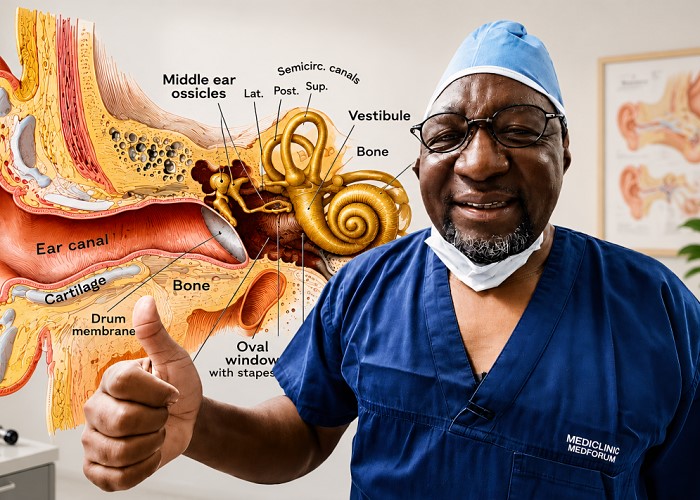
The world’s first 3D printed ear transplant in 2019 by Professor Mashudu Tshifularo and a team of surgeons at Steve Biko Academic Hospital in Pretoria was a feat which has been hailed worldwide, leading to numerous accolades for this medical pioneer, reports Business Tech.
Tshifularo, who has undergone medical training at several institutions, including the University of KwaZulu-Natal, Glasgow University in the United Kingdom, the Sefako Makgatho Health Sciences University (SMU), and the College of Medicine of South Africa (CMSA), has been recognised a number of times for his contributions to medicine – including receiving the Hamilton Naki Award for pioneering the world’s first 3D middle ear implant/transplant.
Over the course of his career, he has received the African Genius Award, been listed in the American Marquis Who’s Who in World Medicine, been recognised as one of Forbes’ Top100 African Innovators in medicine, and named GQ Health Man of the Year.
Tshifularo practices at various medical facilities throughout Gauteng, including Botshilu Private Hospital in Soshanguve and Mediclinic Medforum in Pretoria, where he practices privately.
He is also a Professor at the University of Pretoria, where he is head of the Department of Otorhinolaryngology (ENT).
Additionally, he conducts his clinical trials at Steve Biko Academic Hospital, where he leads the Department of Otorhinolaryngology and Head and Neck Surgery.
When reflecting on his greatest achievement, Tshifularo acknowledged his ground-breaking first middle ear transplant using 3D technology.
“It’s proof that the fourth industrial revolution is here …because I had to use the 3D technology. I was not even aware I was in the forefront, nor that I was the first,” he told GQ magazine.
“This tells us that we are sitting with potential, all of us, including the youth, and the young ones: that there’s something you can do, that can change the world.”
Tshifularo said he would have chosen to become a lawyer or a veterinary surgeon if he had not gone into medicine.
Pioneering procedure
The idea behind his first revolutionary 3D printed bone transplant – on 13 March 2019 – was to address hearing loss caused by middle ear issues, which may result from congenital defects, infections, trauma, or metabolic diseases.
The surgery is suitable for everyone, he said, including newborns.
In that very first procedure, which was done on a patient born with an under-developed middle ear, he and his team replaced the hammer, anvil, and stirrup – the ossicles that make up the middle ear – using bones created by the 3D technology.
“Replacing only the ossicles that aren’t functioning properly carries significantly less risk than known prostheses and their associated surgical procedures,” Tshifularo said.
“We use titanium, which is biocompatible, and an endoscope to do the replacement, so the transplant is expected to be quick, with minimal scarring.”
He added that the method reduces the risk of facial nerve paralysis, which can occur if the facial nerve – in the middle ear – is damaged during traditional surgery.
See more from MedicalBrief archives:
Tuks team’s pioneering ear surgery at Steve Biko Academic Hospital
World-first for Cape Town in endoscopic gynaecology
Quicker test being trialled to help prevent permanent deafness in babies