


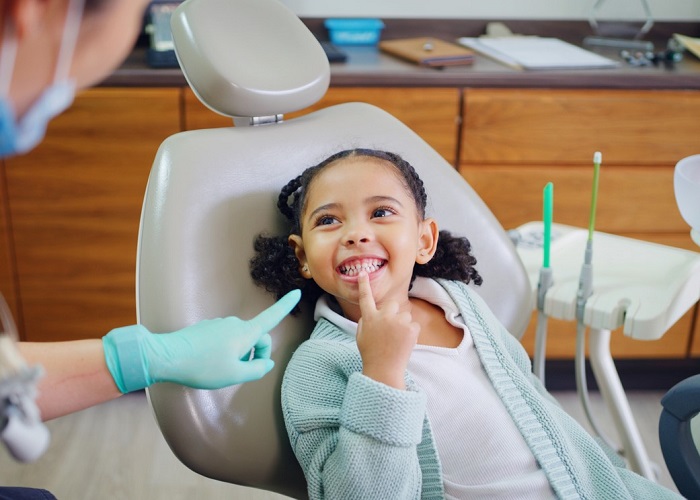
A liquid brushed on to cavities in seconds may spare many young children from pain, infection, and surgery, suggest US researchers, after a trial found that silver diamine fluoride stopped decay in more than half of treated baby teeth.
The treatment requires no drilling, shots, or sedation – although the down side is it does permanently darken the decayed area, they in the study published in JAMA Paediatrics said.
Untreated cavities send thousands of young children in the United States to emergency departments each year. Because hospital doctors usually cannot repair the underlying dental problem, some children continue to suffer from pain and infection, while others eventually need surgery under general anaesthesia.
A low-cost liquid known as silver diamine fluoride, or SDF, may offer a much simpler option. Dentists apply it directly to a cavity with a small sponge-tipped applicator, a process that takes only a few seconds for each tooth. The treatment can stop decay without drilling, injections, or sedation.
Long-used treatment gains stronger evidence
SDF has been used successfully in many countries for decades. In the US, dentists have used it off-label since 2014, when it was approved it for reducing tooth sensitivity.
However, researchers had not yet completed the large clinical trials needed to demonstrate its safety and effectiveness as a cavity treatment. That evidence would be necessary for the US Food and Drug Administration to approve SDF as a drug for treating tooth decay.
A clinical trial led by the University of Michigan has now supplied those data. The phase 3 study, published in JAMA Paediatrics, included 830 children under six. Participants were recruited through dental offices, paediatric medical practices, Head Start and Early Head Start programmes in Michigan, New York and Iowa.
SDF stopped decay in many baby teeth
The researchers found that the product, called 38% SDF, stopped tooth decay in more than half of the affected baby teeth when the treatment was applied every six months.
Traditional cavity treatment usually involves removing damaged tooth material and placing a filling. SDF requires no removal of the tooth. Instead, the liquid is painted directly on to the decayed area.
“This is a very effective and safe treatment – even in children as young as one,” said Margherita Fontana, professor of dentistry at the University of Michigan School of Dentistry and the study’s lead investigator.
Tooth decay is the most common chronic disease among children and affects more than 40% of children in the US.
Fontana said SDF could be particularly useful for very young children, older adults, people with developmental or physical disabilities, and patients with severe dental anxiety. It may also help people who have limited access to conventional dental care or cannot easily tolerate standard procedures.
“If we want more children and families to benefit from this treatment, we need rigorous evidence showing both that it works and that it’s safe. From a public health perspective, if we want broader implementation, we need carefully collected data in US populations, and we now have that," Fontana said.
The research began in 2018 and continued despite disruptions caused by the Covid-19 pandemic.
Findings could support FDA approval
Fontana worked with researchers from New York University, the University of Iowa and Indiana University, as well as the NIH’s National Institute of Dental and Craniofacial Research – the latter provided more than $12m to support the study.
The trial generated the clinical evidence the manufacturer needs to submit a dental caries drug application to the FDA. Elevate Oral Care supplied Advantage Arrest 38% SDF, the product that was tested in the study.
For some children, applying SDF every few months may control the cavity until the baby tooth falls out naturally. In adults, it could function as a long-term treatment or provide temporary protection until a restorative procedure becomes affordable or practical.
“For almost anyone, this can arrest the decay and stop the infection and the pain it causes,” Fontana said. "This could benefit many people."
Study details
Efficacy of silver diamine fluoride on young children with severe early childhood caries
Margherita Fontana, Amr Moursi, Carlos Gonzalez-Cabezas et al
Published in JAMA Paediatrics on 27 July 2026
Abstract
Importance
Dental caries is a highly prevalent yet preventable disease affecting more than 40% of US children, with severe early childhood caries (S-ECC) leading to serious health and economic consequences. This randomised clinical trial addresses critical evidence gaps by evaluating 38% silver diamine fluoride (SDF) effectiveness for caries arrest in young US children with S-ECC to inform US Food and Drug Administration (FDA) regulatory approval.
Objective
To assess the efficacy of 38% SDF vs placebo for arresting active cavitated dentin caries lesions in the primary dentition of US children with S-ECC.
Design, Setting, and Participants
This phase III, multisite, randomised, blind, placebo-controlled clinical trial with two parallel arms had a data collection period from October 2018 to April 2023. Analyses were completed in 2024. Three sites recruited from and treated children in a variety of settings: medical and dental clinics, and Head Start and city/state-subsidized preschool programmes. Enrolled participants included 830 generally healthy children aged 12 to 71 months with S-ECC and active cavitated lesions.
Intervention
Children were randomised to receive either 38% SDF or placebo, applied at baseline and at six months. Clinical examinations were conducted at baseline, three months, six months, and eight months.
Outcomes and measures
The primary outcome was the proportion of arrested lesions at six months after one application. Secondary outcomes included arrest efficacy at three months and after two applications (eight months), and pain at or before six months and eight months
Results
Of 830 enrolled children, 584 (70%) completed the study. Of those lost to follow-up (approximately 30%), 81 (9.8%) were lost due to Covid-19. Participants included 428 females (52%) and 402 males (48%) and were aged 1 to 6 years with high caries experience (mean [SD] decayed, missing, and filled teeth [dmft] (International Caries Detection and Assessment System ≥1), 11.36 [4.56]; range, 1-23). In intent-to-treat analyses, SDF arrested 57.5%, 54.0%, and 50.2% of lesions at 3 months, 6 months, and 8 months, respectively, vs placebo (18.8%, 22.5%, 17.4%, respectively). Differences (99.9% CI) in arrest rates were 38.7% (28.7%-48.6%), 31.5% (21.5%-41.6%), and 32.8% (22.3%-43.2%). There were no differences in pain. Averse events (AEs) were reported by 196 (47.3%) participants in the SDF group and 180 (43.3%) in the placebo group. Most AEs were mild to moderate in severity; 4 AEs (0.6%) were severe. Treatment-related AEs were similar between the 2 groups (SDF = 22.9%; placebo = 22.2%), as were discontinuation rates due to AEs (7.5% for both groups).
Conclusion and Relevance
In this randomised clinical trial, 38% SDF was significantly more effective than placebo for arresting dentin caries lesions in primary teeth in young children with S-ECC, providing a non-invasive treatment for young high-risk children and supporting its consideration for FDA drug approval.
See more from MedicalBrief archives:
Natural dentine restoration may revolutionise dental care
Now scientists are regrowing human teeth