


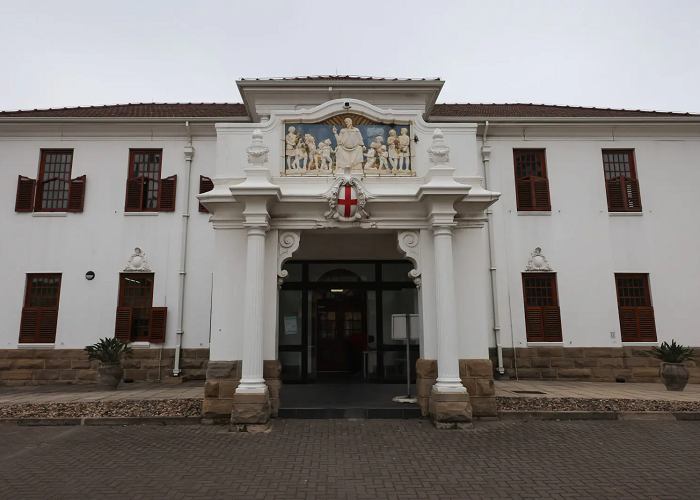
Shut down by the apartheid government for providing care to young patients of all races, Durban’s historic Children’s Hospital is transforming from a ghostly ruin into a lifeline for a new generation, thanks to visionaries like Professor Hoosen Coovadia, writes Biénne Huisman for Spotlight.
An ornate, double-storey building with a bell-tower, sea-facing verandas and large sash windows, Addington Children’s Hospital opened on Durban’s beachfront in 1931. The well-ventilated facility was designed for fighting respiratory illnesses like TB in an era of “sanatorium treatment”.
This was before the 1943 discovery of the antibiotic Streptomycin, which laid the foundation for modern TB medicine.
The facility had 80 beds in five wards named after birds – Kingfisher, Heron, Jacana, Martin, and Loerie – and vivid artworks including 52 stained glass windows depicting fairytales, and sculptures by pioneering artist Mary Stainbank.
A former patient recounts: “I was born at the hospital in 1950 and spent time there in 1957 being treated for pneumonia… My bed was in line with the second window, and I remember so well looking out over Addington Beach.”
Some former nurses recall the hospital’s elaborate murals and mosaics, often somewhat “spooky” at night.
The facility is steeped in history. In the 1980s during apartheid, the hospital, on a section of Durban’s beachfront then reserved for “whites-only”, treated children of all races. This defiance by healthcare staff prompted the ruling government of the time to shut it down in 1984.
Three decades of crumbling decay
Afterwards, the beautiful hospital complex – seven structures spread across 3.5 acres (about the size of a cricket field) – stood abandoned for nearly three decades. Beside the towering provincial Addington Hospital, which adhered to apartheid policy and thus remained operational (treating mostly adult patients), the specialised children’s facility became a forlorn sight: an array of crumbling heritage buildings.
Inside, water dripped through cracks and puddled on floors as shrubs pushed through gaps in the walls. Displaced people sought shelter in the derelict wards and dark corners, living next to children’s iron beds and rusting wheelchairs, amid shattered glass, tiles and washing basins.
In 2009, renowned paediatrician Professor Hoosen Coovadia, who grew up in nearby Wills Road in the Warwick Triangle, was one of a few local visionaries pushing for the hospital to be repaired. A year later, an internal Addington Hospital newsletter broke the news to staff.
The newsletter’s editor Sue Meyer wrote: “I am sure that you have seen something happening along the perimeter of the Children’s Hospital… a building that has seen much neglect and begun to fall apart. But there is such good news… The Children’s Hospital is getting a revamp!”
A public-private partnership
In 2011, Coovadia and Dr Arthi Ramkissoon registered the KwaZulu-Natal Children’s Hospital Trust. Effectively, they established a public-private partnership for renovating the hospital and re-establishing its services, in collaboration with the KwaZulu-Natal Department of Health.
At the time, Ramkissoon said: “My vision is for children to have their physiotherapy and other therapy on the beach. I would like the wheelchairs and the beds to be wheeled out there, so I’m going to try to build some sort of ramp.”
On the provincial government’s side, then MEC of Health Dr Sibongiseni Dhlomo was credited with greasing the bureaucratic wheels to get the project off the ground.
“Today, we pay tribute and say thank you to all the compatriots who have shared our dream and committed their time and resources to make the restoration and reconstruction of this facility a reality,” Dhlomo said in a 2013 speech at the official launch of phase one of the hospital’s rebirth – the reopening of its outpatient wing.
Coovadia and Ramkissoon have since died, but the KwaZulu-Natal Children’s Hospital Trust continues their legacy as the hospital’s renovations continue.
CEO of the Trust, Taryn Millar, says: “This project really was initiated through the efforts of Prof Jerry Coovadia and Dr Aarti Ramkissoon, both obviously very well known in the public health sector. They had the initial connections within the Department of Health to push for this to happen.”
The trust is responsible for fundraising, renovation, building and equipping the facility, she said. “And then it’s handed over to the Department of Health who staff it and will maintain it in perpetuity. I think sensible relationships and partnerships between the public and private sectors are the way forward.”
Shift in focus from HIV to mental health
Coovadia’s seminal work in HIV transmission (see Spotlight’s 2021 interview with him) inspired his original intention for the hospital. “Initial discussions were that it would actually fill the gaps within HIV treatment. But obviously as time goes by, needs change,” said Millar. She adds that today, the precinct’s main focus is on child and adolescent mental health and neurodevelopmental needs.
On a sunny winter’s day, she takes Spotlight on a tour of the premises reached via Prince Street, running parallel to the palm-lined beach. The main hospital building’s entrance facade, with its ceramic sculpture depicting Jesus blessing a group of children, has been restored. Its terracotta roof is now retiled.
The foyer is bright-white with a commemorative plaque to former Durban councillor Mary Siedle, who initially drove fundraising to build the complex in the late 1920s.
Further along, a ceramic plaque reads: “JML and Marie Baumann cot”, referring to John Michael Leonard and Marie Baumann, the founders of Bakers Biscuits on Durban’s West Street (makers of Marie biscuits), who were among those who sponsored a child’s hospital bed for £100 back in the day.
New beginnings
Millar says the centre has treated more than 45 000 child patients since opening in 2013, for conditions including cerebral palsy, autism, cleft palate, and broader neurodevelopmental disorders. Here mothers find support and respite in the hands of healthcare professionals who help them understand and care for their children with special needs.
The centre’s multi-disciplinary team consists of paediatric neurologists, occupational therapists, physiotherapists, speech therapists, dieticians, social workers and psychologists.
Inside the main hospital building, we cross fluorescent-lit corridors to the new Victor Daitz Paediatric Psychology Centre. Images of kingfishers feature in the centre’s signage, a homage to the old hospital’s bird names. Millar points out rooms with educational toys, used for counselling and group therapy.
Inside a boardroom, Millar and fellow board member of the trust, Kim MacIlwaine, spell out further details of the unfolding renovation.
Money and future plans
Another R500m is necessary to finish the entire precinct. Pending plans include a 36-bed child and adolescent in-patient mental health unit. Millar said: “KwaZulu-Natal has 4.3m children of whom about 10% to 20% will develop some form of mental health or neurodevelopmental condition. And across the entire province, currently there are only eight public-sector psychiatric beds available for adolescents. That’s at Townhill Hospital, in Pietermaritzburg.”
MacIlwaine said the mental health need is so vast, “that here, what we do will make just a small dent”.
But at least it’s a start.
Other plans include a rehabilitation ward for neurological conditions, a palliative care ward, and an inclusive children’s playground with special swings, wheelchair-accessible sand and play zones, and “safe retreat” spaces like a make-believe igloo.
To date, the trust has collected more than R200m in donations. “Durban is a very diverse community, which is represented in our funders: the South African Muslim Charitable Trust, the Jewish-based Victor Daitz Foundation; the Hollywood Foundation (the charitable arm of Hollywoodbets), the Elton John Aids Foundation…,” said Millar.
A time-warp and a dream
Millar leads us through the main hospital building. Passing through a door, bizarrely we step back in time, into a dusky unrenovated wing with peeling paint and plaster. This contrast lends a surreal air. Old and new co-existing side-by-side, separated by mere brick walls.
An obituary for Coovadia published in the South African Journal of Science refers to his dream for the hospital. “An unfinished dream of his was restoring the abandoned Addington Children’s Hospital on the beachfront to the KwaZulu-Natal Children’s Hospital… for the care of children with special health needs,” wrote leading South African infectious diseases epidemiologist Professor Quarraisha Abdool Karim at the time.
Today, Coovadia’s daughter, Dr Anuschka Coovadia, serves as board chairperson of the hospital’s Trust, as his dream continues to take shape.
See more from MedicalBrief archives:
Historic KZN Children’s Hospital opens new centres
National Health report details grim state of KZN public hospitals
Patients again having to use the stairs at 16-storey Addington Hospital