


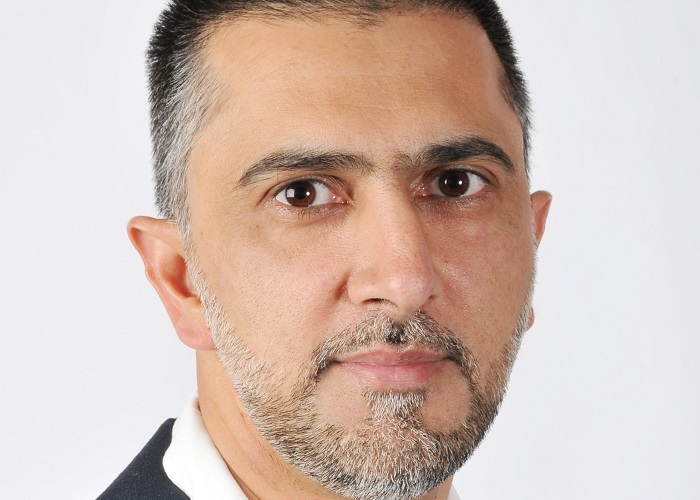
In his first month as new executive director of the National Institute of Communicable Diseases – he started on 1 May – Professor Nazir Ismail (51) had to grapple with a hantavirus outbreak, Ebola preparedness as well as a polio alert, but took it all in his stride, reports News24.
Other impediments included being short of two vital staff and having to cope with a constrained budget hugely affected by funding cuts from the US, but the public health expert has not let that deter him from the core focus of the job.
“The NICD protects South Africa and South Africans from infectious risk. We monitor what’s going on; we respond to what’s going on. We are able to detect things early and accurately before it becomes a bigger problem.
“And the problem with that,” the former World Health Organisation’s TB team lead says, “is that people don’t see that part. You can’t see something like that because you’ve kind of done a good job in stopping it.”
The public health expert described his first month on the job as “a baptism of fire” from day one – when the mayday for hantavirus went up.
In Mpumalanga on holiday with his family at the time, Ismail got a call from Professor Lucille Blumberg, an infectious diseases specialist and former deputy director of the NICD.
A rare and unusual virus had broken out, and the NICD needed to immediately initiate an outbreak response. But Ismail would have to manage this with two vacant positions: an outbreak response lead and a deputy director.
His first official action was to navigate, with Blumberg’s help, the emergency response to hantavirus, which eventually killed three people.
“For us to detect hantavirus within 24 hours was ground-breaking. I know, I worked at the WHO as well. This is world-class,” Ismail says, commending the retired Blumberg for her pivotal role and the networks she had built that assisted immensely. Even the WHO assembly applauded the NICD and South Africa’s rapid response.
Then came Ebola with its rare Bundibugyo strain, which is driving a major outbreak in the DRC and has spread to Uganda; an unusual polio case in Cape Town found in wastewater; an inherited listeria court case with an annoyed judge; and a list of media queries.
He also had to find time to write a hantavirus journal article with international partners like the Brits, the Dutch and the Swiss, and attend a ministerial cancer conference with Health Minister Aaron Motsoaledi.
His new administrative work included multiple financial year-end sign-offs, stepping into the work of two vacant senior management roles, managing relationships with the Department of Health and NICD’s parent company, the National Health Laboratory Service (NHLS), while trying to lead the R400m public health sentinel through a tricky financial period.
He says: “Let me make it clear to politicians – we’re there to serve. We are an honest broker. If there’s anything untoward – I’ve got principles.”
His style is very responsive, and “if I see it looks reasonable, it’s approved”.
“Deal with consequences later.”
As head of South Africa’s first line of defence against infectious diseases, time is not counted in money, it’s counted in lives, he adds. Value for (taxpayers’) money is imperative.
“I will work on efficiency,” he says of what the board expects. “I need to further optimise – look at what’s being done and where the gaps are. But at some point, I’m going to need money.”
The funding model of the NICD is shredded, part of the problem being structural. The NICD is not a legal entity. It sits within the NHLS – a commercially-driven lab services company – while its main client is the national Department of Health. The funding, through the NHLS, is ring-fenced but has been in decline. Added to that is that provinces are not paying NHLS for lab services, slashing its earnings.
The NICD also relies on grant funding from international entities, including the US Centres for Disease Control (CDC). That funding has been cut, posing a high sustainability risk for the NICD.
Last year’s NICD budget was R450m; the previous year was R480m.
At a parliamentary meeting he attended earlier in May, the Minister, Health department officials and MPs all said the NICD’s funding model is yet to be resolved. The National Treasury, they say, “is due to make a determination as soon as it is ready”.
The Minister said this has been unresolved for 10-15 years.
Ismail says the NICD runs on roughly 0.1% of the national health budget, yet it is the first call in every outbreak – Covid, hantavirus, Ebola, polio, the next pandemic.
Prevention, he argues, is not a cost but a saving – the TB caseload that halved over 10 years proves it, and the economic analysis will show exactly how much money that saved.
The nearly 80% cut from the US CDC funding is his lever: “It really highlights an underlying problem – that we should pay for what benefits us. We should pay for our own.”
For now, he is focused on the people and the efficiencies needed.
“What I really like about this job is that when people put their name on (a report), I know there’re names I can trust. What they’ve written, they will defend,” he says of the NICD team of health professionals and experts.
It is one of the reasons he took the job. “There’s still a core of really good people. And I don’t want them to leave. We need to keep that stable.”
Before leading and revolutionising the WHO’s approach to TB globally, he led the Centre for Tuberculosis at the NICD for eight years. That’s where he got to know many of the colleagues with whom he works today.
He returned to South Africa from Geneva, Switzerland, “because of family”. Two of his three children are in university – studying medicine – and the third is finishing high school. His dad is older, and Ismail wants to spend more time with him.
Ismail says he chose to return initially to academia, and was almost settled as a professor at Wits University when he got sent the NICD director job posting.
With his background as a GP, a clinical microbiologist, an academic, a researcher and a public health specialist with global standards, “you kind of feel you have done all of this and maybe I could add value and make a difference (at the NICD)”.
So, he applied, made a presentation and was offered the job for the next five years.
Ismail’s urgency is not only institutional but also personal.
His mother died at 44 of kidney failure. His father nearly followed at 46. He did the arithmetic. “My genes are not very strong to live long,” he says. “The average is 45, clearly. Every year after is a bonus year. I need to make a difference.”
Now, six years over his self-proclaimed average, he is moving rapidly to create a long-term impact.
“I have no regrets being back in sunny South Africa, despite the water and electricity issues. It’s a fantastic country. And I think I can make a big difference here.”
See more from MedicalBrief archives:
How SA team homed in on hantavirus
New antibiotic-resistant genes identified in TB in 23-country analysis