


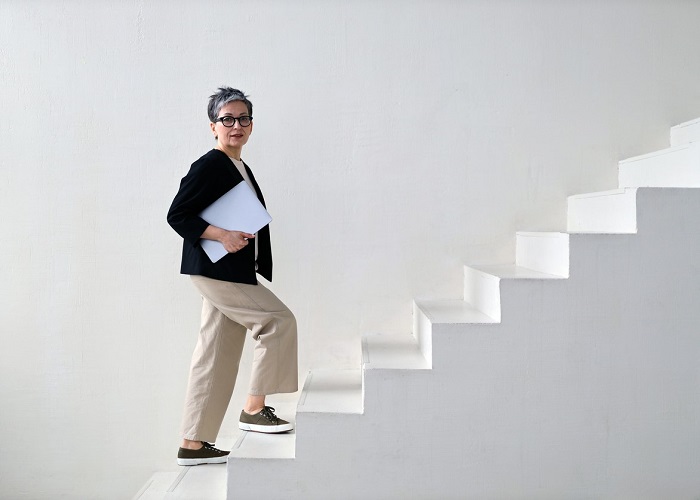
A group of scientists has suggested that reducing your risk of at least 13 types of cancer is as easy as jogging up and down the nearest steps for three minutes or standing up from your desk or couch for 30, reports The Washington Post.
Either strategy might help drop your risks of certain cancers by as much as 7% – according to their new study which examines how the ways we move, and don’t move, during the day affect our chances of malignancies.
The study, published in BMC Medicine, is one of the first to examine in detail how replacing sitting time with almost any kind of activity alters cancer risk.
Relying on extensive activity data from nearly 60 000 men and women, it used statistical models to determine which movements, from standing to strolling to rushing around the block, seem most strongly associated with fewer cancer cases, including breast, colorectal and lung cancers.
“The reassuring finding is that every movement contributed,” said John Mitchell, a senior research fellow at University College London’s Institute of Sport, Exercise & Health, and the study’s lead author.
But they didn’t contribute equally.
“Some choices,” Mitchell said, “proved more beneficial than others.”
Substantial evidence links uninterrupted sitting with heightened risks for heart disease, Type 2 diabetes, obesity and other conditions.
Sitting also makes us more vulnerable to many cancers, studies show. Ideally, we should reduce the amount of time we spend seated every day and be more physically active instead.
But how? Does standing up count? Do we need to move around? Is it enough to meander slowly down the hallway? Or should we raise our heart rates and break a sweat?
Those questions matter because many of us are tied to our desks and schedules. In that case, what are the most realistic and efficient options for sitting less?
The link between activity and cancer risk
Past studies of sitting and health generally focused on one change, such as standing more often, and not multiple types of movement and how they might affect sitting’s health risks in comparison to one another.
They didn’t tell us, in other words, if standing up for a few minutes would undo the effects of sitting as potently as climbing stairs.
So, for the new study, the scientists drew records for 59 218 adult men and women who’d joined the large-scale UK Biobank health study and worn a sophisticated activity tracker for a week.
Using machine learning algorithms, the researchers parsed everyone’s activity data and determined how much time they spent sitting (generally around 10 hours) or in other activities on most days, including standing up; light movement, such as leisurely walks; moderate activity, meaning brisker walks; or vigorous activities, which would get people breathing hard, such as running to catch a bus.
They also checked medical records for eight years or so after people joined the Biobank, to see whether they’d developed any of 13 cancers that have been associated with inactivity.
The best ways to break up sitting
With those mountains of data, the researchers then created complex, statistical models of what theoretically would happen if people replaced some of their normal sitting time with movement.
First, they looked at standing. Compared to non-stop sitting, standing up for any period of time reduced the cancer risks associated with sitting.
But standing was about half as potent as moving. In general, moving in any way, even short, gentle strolls, for about 15 minutes dropped cancer risks to the same extent as half an hour of standing.
The gains were even more striking when the researchers focused on different intensities of movement. Again, standing was better than sitting and light activity was better than standing.
But vigorous movement – such as hurrying up and down the stairs or rushing to the bus stop or station – was, by far, the most effective. Three minutes of daily vigorous activity dropped cancer risks to the same extent as 90 minutes of light-intensity movement.
“I think these results show there can be different routes to the same goal,” said Emmanuel Stamatakis, a professor of physical activity and health at Monash University in Australia, and senior author of the new study.
If we can’t find 90 minutes to wander around the block or from cubicle to cubicle, we could instead head for the nearest stairwell and jog up and down for a few minutes.
“This is a really interesting paper,” said Lora Giangregorio, an exercise scientist at the University of Waterloo in Canada. She studies physical activity and health but wasn’t involved with the new study.
“It is encouraging that adding movement or standing is associated with reduced risk of cancer. But what stuck out for me was the finding that ‘only three minutes of additional vigorous physical activity in place of any other intensity was associated with lower cancer risk’.”
Many of us can probably find a way to fit those three strenuous minutes into our day.
‘Any movement counts’
The study was observational and shows links between more activity and lower cancer risk but doesn’t prove the additional movement directly caused that effect.
It also doesn’t explain how moving instead of sitting changes the likelihood of cancer, though muscles release a slew of biochemicals when they contract, Stamatakis said. Some of them are likely to jump-start physiological processes that dampen the development or progression of cancer.
The study doesn’t say, either, whether we should lump our movement time into a single session or spread those three minutes of speedy or 90 minutes of laid-back activity throughout the day.
More study is needed, Stamatakis and Mitchell agree.
But, for now, the takeaway is to rise from your chair whenever you can, Stamatakis said, even if it’s just to stand.
“Any movement,” he said, “counts.”
See more from MedicalBrief archives:
Brief bursts of hard exercise may slash disease risk – large global study
Short exercise bursts can trigger anti-cancer signals – UK study
Exercise may cut cancer mortality – SA study