


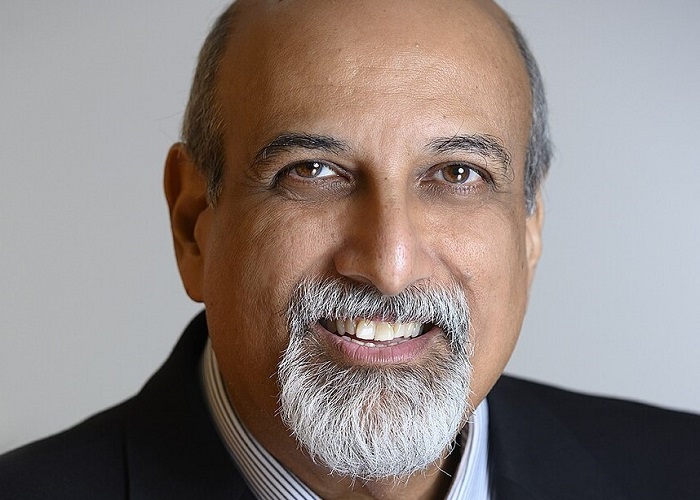
Leading South African scientist Professor Salim Abdool Karim, who believes excellence should be the only standard, says he is inspired – in science – by imaginative thinking such as that of American comic publisher Stan Lee, co-creator of Spider-Man, discovers Biénne Huisman from Spotlight.
On a summer’s day nearly eight years ago, while hiking in the Drakensberg, Professor Salim Abdool Karim’s smart watch pinged. It was a message that would turn his world upside down.
“ProMED (the Programme for Monitoring Emerging Diseases) alert! Undiagnosed pneumonia – China.” It was December 2019, the first public announcement of Covid-19 issued by the reporting system for tracking outbreaks.
As the pandemic unfolded across borders, Abdool Karim’s friend and colleague, visionary HIV researcher Dr Gita Ramjee, became one of South Africa’s first Covid-19 fatalities. Abdool Karim says she was probably the sixth person to succumb to the virus in the country.
He recalls phoning the hospital in uMhlanga, outside Durban, where he intended to visit her at the intensive care unit. But hospital staff would not allow visitors – not even Ramjee’s husband.
As head of South Africa’s expert committee providing high-level strategic advice on Covid-19, Abdool Karim became a prominent face of the country’s response to the crisis. As such, he walked a tightrope between great uncertainty, scientific endeavour and the politics of policy and public reassurance.
Amused, he recalls being told by his children that he was “trending on Twitter” after a live broadcast at the time. This terminology was not familiar to him back then, he says.
Negotiating common goals
Indeed, while Abdool Karim’s career was doubtlessly built on his foundational research into HIV treatment and prevention, it is his finesse for negotiation that has seen him turn scientific discovery and ambition into political mandate. While not having shied away from crossing swords with regimes: apartheid and Thabo Mbeki's Aids-denialism, one of the “lowest points of (his) life”, his ability to connect diverse stakeholders to achieve common goals within science is noteworthy.
Today, the renowned clinical infectious diseases epidemiologist is director of the Centre for the Aids Programme of Research in South Africa (CAPRISA), Pro Vice-Chancellor of Research at the University of KwaZulu-Natal, and holds professorships at Columbia, Harvard and Cornell University in the United States.
A nickname that stuck, forced evictions and buses to school
Perhaps a large part of Abdool Karim’s charm is his knack for storytelling, which he does with attention to detail and without rush. One story he likes to tell is how an Afrikaans teacher at Gandhi Desai High School in Durban inspired his nickname “Slim”.
To American science journalist Amy Maxmen, he recounted the memory. “During apartheid we had to take Afrikaans language classes, which I didn’t like because I associated it with racial oppression. My Afrikaans teacher once scolded me: ‘Jy dink jy is slim’, which means, ‘You think you are clever?’ It stayed with me as it sounded like Salim. Plus, I was quite rotund then, so the name made (ironic) sense and it stuck,” he is quoted in an interview published in 2009 in the Journal of Experimental Medicine.
To Spotlight, he relays how his family was forcibly removed from central Durban when he was 10. “It was 1970 and they moved Indian people out of the city to a new township that had just been started, called Chatsworth. And so we moved to Chatsworth. I grew up there and finished my primary school there. But I decided to go to a city high school.
“Every day I would do this 20km trek, mostly by bus, arriving in the city early in the morning then walking to the school. It was Gandhi Desai High School, the best school in Durban at the time. One of the best decisions I ever made.”
Abdool Karim’s pursuit of excellence grew from here. “When I was in high school, if I didn’t get 100% for a test or an exam in maths or physics, I was depressed. I would be mad because I was a perfectionist. I wanted to get it right.”
Abdool Karim is speaking to Spotlight inside his office in a glass-encased building on the University of KwaZulu-Natal’s medical campus. This is where he completed his medical degree in 1983 alongside former classmates, present Health Minister Dr Aaron Motsoaledi and Deputy Health Minister Dr Joe Phaahla. Here, his mentor was luminous HIV researcher Professor Jerry Coovadia.
“I joined the underground movement and used to see Jerry at all the political meetings,” he says. “And Jerry was very accommodating, I would have lunch with him and we’d talk about apartheid, about politics. We’d talk about what it was going to take for us to get liberated in this country, and so on.”
On call to fix the MRC
He details a recollection from nearly three decades later. It was 2012, and he received a call from Motsoaledi asking that he step forward to “fix” the South African Medical Research Council (SAMRC).
“I get this call and it’s from Minister Motsoaledi. He tells me: ‘I need you to come and help me. Come to Pretoria on Friday and I’ll see you at 10:30 at the CSIR (the Council for Scientific and Industrial Research).’ So, I go to the CSIR at the conference centre. And he sat me down and said: ‘This is the problem. The board of the MRC has given up. They can’t find a president for the MRC. They’ve advertised three times. It’s a big problem; the MRC is in serious trouble. It’s directionless. It’s in deep, deep trouble. Can you go and fix it?’ I thought about it. I said: ‘Okay’…”
Soon enough, he headed a massive audit of the institution, laying off a third of the staff and closing two-thirds of its research units. He recalls: “Basically, I reached a set of conclusions about what the MRC needed to do for its sustainability. It was a difficult time. The staff had their lawyers, I brought in my own lawyers. For example, at that stage they had three diabetes research units, because the staff couldn't work with each other. I shut them all down, fired all these people. Essentially, I got rid of all of the people who were not contributing to the mission.”
At the time, the council's budget was around R240m. Abdool Karim needed a higher budget allocation for the “new mission”, but when asked for more money, Motsoaledi said there was none.
‘I was mad, irritated, frustrated’
It was in Cape Town in the Mount Nelson Hotel’s restaurant that Abdool Karim would strike a remarkable deal. “I was mad, irritated, frustrated, and I had to go to dinner. I had a pre-set dinner with Trevor Mandel from the Gates Foundation, a friend (Mandel is President of global health at the Gates Foundation, since 2011). I was not in the mood for this dinner,” he recalls.
“So towards the end of the starter, Trevor says to me: ‘What’s wrong? I can see something is wrong.’ So I said: ‘I don’t need to worry you with my problems, but I’m planning to resign tomorrow from the MRC.’ And he says: ‘Why?’ I said: ‘I met with the Minister. He’s not coming to the party.’ And if I don’t resign, then I’m not staying true to what I believe in. I have to increase the budget.”
The evening progressed, as the men continued eating and chatting. Abdool Karim adds: “Then Trevor says to me: ‘Actually, I can help. I can give you R100m from the Gates Foundation.’ So I said to him: ‘I really can’t ask you about that.’ He said: ‘No, no, we can do this. We can do this.’ As we’re finishing the main course, he says: ‘Actually, no, I won’t give you R100m. I’ll give you R100m if the government matches it with R100m. So I say: ‘would you give this to me in writing?’”
Soon after, Abdool Karim got his letter from Mandel. “I go with that to meet the people in Treasury. And I know several of them because we were in the ANC and activists together. Some I know from school. I explain this thing to them. It took about two to three weeks and I get the letter back saying yes. They’re providing the R100m.”
During a subsequent meeting with officials at Treasury, they told Abdool Karim of “a competitiveness fund” from which they were now willing to commit an additional R200m.
“So my three-year budget; the council’s budget allocated over three years, it was now effectively nearly tripled,” says Abdool Karim, describing what some in the field consider his most striking professional achievement.
His advice to current SAMRC President Professor Ntobeko Ntusi is threefold. First, directing funding outward to South African universities and external scientists. He says when he arrived at the council in 2012, about 83% of funding was being spent internally. He suggests a 50-50 split. Second, relentlessly pursuing excellence and international competitiveness.
“The moment you do all of that, the money flows better,” he says. “You can’t stand still in science. You have to move forward. You have to be improving. Because if you don’t, you’re essentially going backwards.”
And third, focusing on measurable returns on investment through impact on health policy.
Scientific power couple
Family is integral to Abdool Karim’s scientific journey. With his wife and collaborator, Professor Quarraisha Abdool Karim, an equally accomplished infectious diseases epidemiologist, he founded CAPRISA in 2002. One of their scientific milestones was co-leading the landmark CAPRISA004 tenofovir gel trial in 2010, proving that an antiretroviral gel could block transmission of HIV and genital herpes in women.
Even though the gel never made it to market (it disappointed in subsequent trials), CAPRISA004 helped prove that antiretrovirals can prevent HIV infection as opposed to just treating it, thus laying the foundation for modern HIV Pre-Exposure Prophylaxis (PrEP).
The couple met on campus in 1987, shortly before Abdool Karim left to pursue a Master’s degree in Epidemiology at Columbia University in New York. They kept in touch, with Abdool Karim proposing marriage over the phone. In January 1988, they married in Durban and returned to New York together.
Today, CAPRISA’s reception area bears witness to the scientific power couple’s contributions. Walls are lined with awards and printed copies of journal articles, cabinets are packed with trophies. In the reception area, visitors are greeted by a large metal rendition of French sculptor Auguste Rodin’s The Thinker.
Inspiration: Spider-Man creator Stan Lee
Inside Abdool Karim’s office on a boardroom table, there is another smaller sculpture of The Thinker alongside a small bust of Nelson Mandela and a figurine of Marvel Comics creator Stan Lee, who conceptualised Spider-Man. These three items, he says, encapsulate their philosophy of excellence at CAPRISA.
“So, we are a thinking organisation,” he says. “That’s what we do. Thinking, plus imagination. Because what does it take to dream up Spider-Man? I mean, its imagination on steroids.” Referring to the bust of Mandela, he stresses the importance of purpose, creating scientific output that betters society.
Abdool Karim concluded his 2023 book Standing up for Science, calling for scientific solidarity across borders. “Most of us in global health appreciate that, as humanity, our greatest hope in mitigating the impact of future pandemics lies in working together,” he wrote.
This observation would seem especially prescient two years later when the global HIV response was rocked by sudden disruptions in aid from the United States.
In a Spotlight op-ed published in November 2025, he wrote: “While the US government is perfectly entitled – as it sees fit – to stop funding for any of its projects, the deliberate disruptiveness of its implementation was sadly designed to be cruel.”
But far from wallowing in the setback of the aid cuts, his op-ed showed an eagerness to chart a more sustainable way forward. That problem-solving energy is again on ample display in his interview with Spotlight, as it also is in his book.
Rather appropriately in light of his long career, he ends the book with the words: “Science represents one of the most powerful tools we have to help change the world for the better. That is an idea worth standing up for.”
See more from MedicalBrief archives:
Stellenbosch University honours Professor Abdool Karim
Covid-19 has made Prof Abdool Karim a media celebrity
Lasker research award for Abdool Karims