


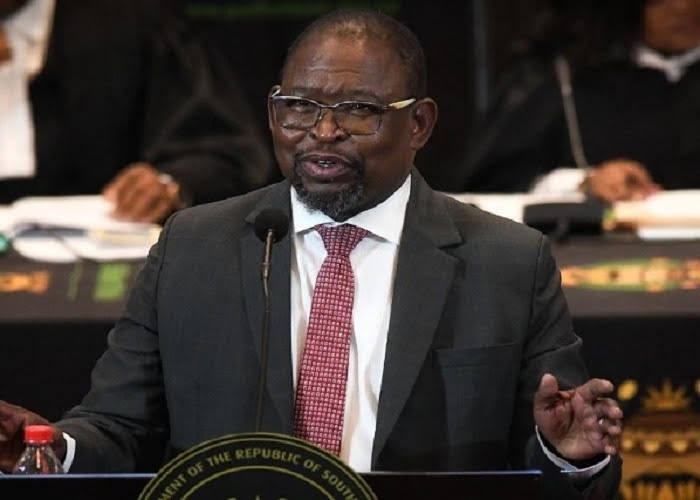
Finance Minister Enoch Godongwana opened the door for negotiations between government and the parties opposing the National Health Insurance (NHI) Act last week, but while some appear steadfast in continuing with legal action, others are cautiously open to renewed talks.
With nine cases brought by various groups before the court, the NHI could be caught up in legal wrangles for years to come, which led to Godongwana suggesting in Parliament last week thatall of the cases should be withdrawn and those involved should sit around a table and reach an agreement.
But most of the organisations who are litigating against the Act have poured cold water over his suggestion that they reach any kind of settlement.
Many expressed scepticism about the state’s willingness to consider their standpoint, as few changes were made when the policy underpinning the Act was drafted or when Parliament considered the NHI Bill, reports Business Day.
Godongwana’s call for consultation to reach a settlement was exactly what Parliament’s law-making process should have facilitated, said Mireille Wenger, the Western Cape’s Minister for Health & Wellness.
“However, when the NCOP (National Council of Provinces) considered the Bill, it failed to facilitate proper public participation, especially regarding the Act’s major impact on provincial healthcare,” she said.
“We therefore continue to believe that the public process was flawed and that the NHI Act should be declared invalid and unconstitutional.”
The Western Cape provincial government is one of the parties that have challenged the Act in court.
The others include trade union Solidarity, the Board of Healthcare Funders (BHF) and the Health Funders Association (HFA), the South African Private Practitioners’ Forum (SAPPF), the SA Medical Association (SAMA), the Hospital Association of SA (Hasa) and business lobby group Sakeliga.
Hasa said it would not have embarked on litigation had the government been willing to engage in constructive discussion, according to CEO Dumisani Bomela, while the BHF said the state had blocked all of its previous proposals for expanding coverage, improving affordability and integrating public and private healthcare services.
The BHF said it had lost faith in the government’s “consultation” efforts, reports News24.
“Over several years, the BHF has put forward a range of practical proposals to government to expand coverage and improve affordability, but they have all been blocked. It is in this context, and to protect both patients and the sustainability of the health system, that the BHF has had no alternative but to seek clarity from the courts.”
SAPPF CEO Simon Strachan said the organisation was willing to participate in “true and open dialogue” about achieving UHC but questioned why the government has yet to respond to the various alternatives to the Act that have already been put to it.
These include separate proposals from the Universal Healthcare Access Coalition and Business Unity SA (Busa), both of which were submitted to the president more than a year ago. UHAC is a coalition of healthcare organisations, including the SAPPF.
“You don’t need the NHI Act to achieve health reform … or universal health coverage,” said Strachan.
The NHI Act would need to be “taken off the table” for litigation to be dropped, he added.
HFA CEO Thoneshan Naidoo said the organisation has always sought to work with the government to improve access to healthcare, while Sakeliga executive director Russell Lamberti said the NHI is an “unacceptably extreme proposal” that should not be the anchor for an industry settlement.
Solidarity researcher Theuns du Buisson said the organisation has been open to negotiating since the very beginning, but on strict terms. “We won’t settle on anything that contains any form of NHI,” he said.
The day after Godongwana’s suggestion, Craig Comrie, CEO of medical scheme Profmed, had said he welcomed the chance to negotiate and was looking forward to an invitation to sit down and talk.
Daily Maverick had suggested that several of the other bodies that have brought cases against the NHI have a very real interest in avoiding a court case, particularly because it may imply they are trying to prevent poor people from getting proper healthcare.
Some will be happy to negotiate because they know that most of the discussions will boil down to money. There might be debates about emergency treatment, the treatment of children or the treatment of cancer, but in the end, it comes down to rands and cents – and theoretically, a path to negotiations.
Some will be trying to keep their industry or the companies within it alive, while others will have a very different motive.
SAMA, for one, while not averse to discussions with government on the NHI, is unlikely to accept anything that would prevent its members from being able to choose their employer. If, for example, the implementation of the NHI meant they could only work for the government, SAMA would never agree.
Instead, it will no doubt fight to the bitter end, which will inevitably lead to a court case.
The organisation said that engagements with Motsoaledi on other matters as recently as last week had led to an agreement that the parties would have a “dedicated engagement” on the NHI.
“Litigation has been pursued only as a last resort, after extensive efforts to engage constructively through the legislative process, including submissions to Parliament, petitions to the National Council of Provinces, and correspondence with the President did not elicit meaningful responses,” SAMA said on Tuesday.
It added that “real progress can only be made through meaningful engagement between government and the stakeholders integral to the healthcare ecosystem”.
In his comments last week, Godongwana suggested that the basis for an agreement is that all stakeholders now endorse the UN goal of UHC – that nobody should be denied healthcare because they are too poor to pay for it.
He had said that settling the legal impediments blocking the NHI would accelerate the goal of achieving UHC – this while speaking in the National Assembly in the debate to pass the Appropriation Bill, aimed at addressing the funding gap created by Pepfar’s withdrawal .
He had said: “I believe we can find a solution. The interesting thing is that both protagonists in court proclaim their support for universal coverage and access. It is my submission that these parties must meet and craft a settlement.”
However, Health Minister Aaron Motsoaledi, who was present for the debate, was less enthusiastic.
“The Minister has noted the remarks … as a proposal to all the stakeholders, and if a need arises, will engage Minister Godongwana through the relevant channels,” said Health spokesperson Foster Mohale.
In contrast to Motsoaledi’s determination, the Treasury has never endorsed the NHI and, over the years, has raised formal concerns with the Presidency regarding the constitutionality of the Bill and the lack of detail on the system’s financing.
Others contesting the NHI have a political motive.
The DA is using its legal opposition to the NHI to show its voters that it will continue to fight for them, while AfriForum, which has not lodged a court application, has said it will issue a summons to stop any harm to any patient who could be affected by the NHI when it is implemented.
This means that even if there is a truce and the current legal actions are withdrawn, it would not be the end of the story, according to Daily Maverick.
The ANC, of course, is using the NHI as a campaigning tool, and is well aware of the power of this issue, meaning some within the party also have no interest in negotiation – they want to be seen to be fighting for their voters.
In addition, it sometimes appears that the ANC is not 100% behind the NHI.
Last year, Godongwana refused to implement the National Department of Health’s call for the medical aid tax credit to be cancelled, saying that doing so would be an “attack on the middle class”.
In fact, even the ANC’s adoption of the NHI came as a surprise.
While the first mention of the phrase might have been at the party’s Polokwane conference in 2007, it was only at the ANC’s national general council in 2010 that it took any concrete form. But even then, it was not the major point of discussion among delegates and appeared to be almost an afterthought.
Since then, virtually all of SA’s Finance Ministers have failed to embrace the concept.
The only one who appeared to show some support for it was Malusi Gigaba, appointed at the height of Jacob Zuma’s populist phase.
The ANC has also never satisfactorily explained how the NHI would be funded, which makes this issue the Achilles' heel of the party.
Yet Motsoaledi has consistently been a strong proponent of the NHI, and would be risking his political career to accept many concessions during negotiations.
The ANC also needs to demonstrate to its voters that it is delivering something significant. If it concedes too much in negotiations, the concept of “universal healthcare” could lose its essence
Another critical aspect is that it is not clear whether the NHI, as the ANC currently wants to implement it, is constitutional.
Those who oppose it believe it is not, which means they could negotiate for a long time, knowing they could still go to court if negotiations failed.
They might see Godongwana’s call for a truce as a concession that the ANC knows it cannot win this battle.
Meanwhile, on the sidelines of the World Economic Forum (WEF) in Davos, Switzerland, leading South African epidemiologist Professor Salim Abdool Karim delivered a clear message: the future of healthcare will depend on bold collaboration, universal access, and greater self-reliance – particularly for countries like South Africa, reports IOL.
Abdool Karim said the WEF discussions offered valuable lessons for countries like South Africa who are grappling with inequality and access to care.
At the centre of those lessons he said, was the principle of universal healthcare. “The NHI is just one of many mechanisms under discussion,” he said.
“What’s critical is not the model itself, but the goal – universal healthcare. Right now, South Africa has a serious problem with access, and we need to fix that.” He said discussions in Davos highlighted the importance of innovative public-private partnerships as a way to expand healthcare coverage without overwhelming the public purse.
“There are lessons we can take from these global discussions about how partnerships between the public and private sectors can help make universal healthcare a reality,” said Abdool Karim.
Bill objections
On the Special Adjustment Bill, Gondongwana said this underscored the need for self-sufficiency – and in his Medium term Budget Policy Statement, allocated an additional R750.4m to the Department of Health, reports The Star.
A total of R590.4m has been allocated for provinces through the District Health Programme grant for the HIV component and R130.2m for the South African Medical Research Council (SAMRC) for critical research.
The National Assembly also passed the Tax Administration Laws Amendment Bill and the Taxation Laws Amendment Bill, with the MK Party, EFF, UAT, ATM and National Coloured Congress objecting.
Responding to the debate on the Adjustment Appropriation Bill, which made R10.1bn available to departments’ budgets, and to which the MK Party, the EFF and the UAT objected, the Minister emphasised that this made provision for unforeseen spending, repairs and rehabilitation of infrastructure damaged during disasters.
“If you do not vote for this budget, you are actually saying that infrastructure must not be repaired,” he said.
The Bills will be sent to the National Council of Provinces for concurrence.
IOL – WEF26: Prof Salim Abdool Karim says SA must drive its own path to universal healthcare
News24 article – Godongwana calls for truce on NHI (Restricted access)
News24 article – Doctors, Motsoaledi agree on NHI talks (Restricted access)
See more from MedicalBrief archives:
Pepfar fund debacle should be wake-up call, say MPs
Treasury bails out HIV/Aids projects blindsided by Pepfar cuts
Budget trimmed, but emergency health funding likely
President seeks top court intervention over NHI Act ruling