


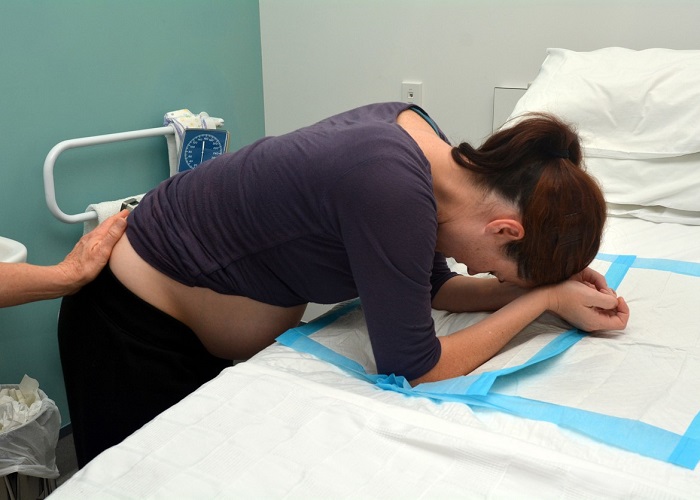
It’s usually more dangerous for women to give birth lying down, so why do they? Turns out it’s all because of a Frenchman who decided it was more convenient – for men, reports the BBC.
For thousands of years, across the world, women tended to give birth in an upright position – whether kneeling as per Cleopatra, using birthing stools and chairs, or squatting. In fact, squatting can enlarge the pelvic diameter by at least 2.5cm, while working with gravity makes it far easier to give birth.
So why do so many women today give birth on their backs?
“There is a generalised ignorance among professions and pregnant women about the physiology of birth,” said Janet Balaskas, founder of the Active Birth Centre in the UK, and author of a number of books detailing how mothers can take control of their birth experience.
In 1982, Balaskas published an “active birth manifesto” that became the central tenet of her organisation.
“Worldwide, and for thousands of years, women have spontaneously laboured and given birth in some form of upright or crouching positions,” the manifesto reads. “Whatever the race or culture… the same upright positions predominate.”
Most women in post-industrial countries are confined to hospital in recumbent positions, Balaskas said.
“This practice is illogical, making birth needlessly complicated and expensive, turning a natural process into a medical event and the labouring woman into a passive patient. No other species adopts such a disadvantageous position at such a crucial time.”
Other experts agree. In fact, giving birth lying down is a relatively modern phenomenon, Hannah Dahlen, Professor of Midwifery at Australia’s Western Sydney University, wrote in a 2013 op-ed for The Conversation.
Pregnancy as ‘illness’
It’s only in the past 300 to 400 years that women have been largely giving birth on their backs. They can thank a French man named François Mauriceau. He claimed that the reclining position would be both more comfortable for the pregnant woman and more convenient for the male physician attending to her (there was already a movement emerging to dispense of midwives and instead have male surgeons present at births).
Mauriceau viewed pregnancy as an illness. In his 1668 book The diseases of women with child and in child-bed, Mauriceau advised: “The best and surest is to be delivered in their bed, to shun the inconvenience and trouble of being carried thither afterwards.”
However, some scholars argue that the change in birthing position may actually be due to another Frenchman who lived the same time as Mauriceau – King Louis XIV.
“Since Louis XIV reportedly enjoyed watching women giving birth, he became frustrated by the obscured view of birth when it occurred on a birthing stool, and promoted the new reclining position,” wrote Lauren Dundes, a Professor of Sociology at McDaniel College in Maryland, US, in her 1987 paper on the evolution of birthing positions.
Regardless of how giving women birth on their backs came about, the trend stuck, much to the detriment of their birthing experience.
“Birth has become institutionalised, with options such as home birth, which is more conducive for many women wanting a physiological or ‘natural’ birth, declining,” said Balaskas.
Proven by science
The main reason women have given birth in upright positions for so many thousands of years is simple: gravity. A baby has to travel downwards through the birthing canal, and gravity is beneficial to the process. It has been shown that left to their own devices, women will instinctively lean forward during labour – not backwards – adopting positions such as squatting, leaning forward on their hands and knees, or leaning against a low piece of furniture.
A 2013 review of 25 studies involving more than 5 200 women noted that other important outcomes for women who gave birth upright and mobile rather than lying down in bed included “a reduction in the risk of Caesarean birth, less use of epidural as a method of pain relief, and less chance of their babies being admitted to the neonatal unit”.
The review did note that more studies were needed for women in high risk groups – some studies have shown an increase in blood loss in upright birth positions.
Upright birthing positions have also been found to decrease the amount of time a woman is in labour.
“Labouring upright and giving birth upright have advantages for both the mother and baby,” wrote Dahlen in 2013, listing benefits that included more efficient contractions, less pain, fewer forceps, vacuum births and episiotomies, and better oxygenation of the baby in the uterus, as the aorta is not compressed by the uterus.
In 2011, she and colleagues conducted a study on women in labour to understand whether the birth setting impacted the position they adopted while giving birth. They looked at two settings – birth centres, where supportive equipment like balls, birth stools and bean bags were available, and delivery wards, where a medical hospital bed was the only option.
They found the women in birth centres were far likelier to adopt upright positions during the first and second stage of labour compared with a delivery ward setting: 82% of women did so in the birth centres compared with 25% in delivery wards.
There is now awareness in Western countries of the concept of active birth, said Balaskas, an approach that promotes the mother’s ability to move freely and instinctively during labour, and adopt upright positions, rather than lying on her back tethered to machines and monitors.
However, Caesarean rates continue to rise “alarmingly”, she says.
Guidelines from Britain’s National Institute for Health and Care Excellence (NICE) advise that women in labour “should be discouraged from lying supine or semi-supine in the second stage of labour and should be encouraged to adopt any other position that they find most comfortable”.
BBC News article – Women were never meant to give birth on their backs (Open access)
See more from MedicalBrief archives:
Home births as safe as hospital births — international study
Home births 3x more dangerous than hospital deliveries
Induction at 39 weeks lessens likelihood of C-section