


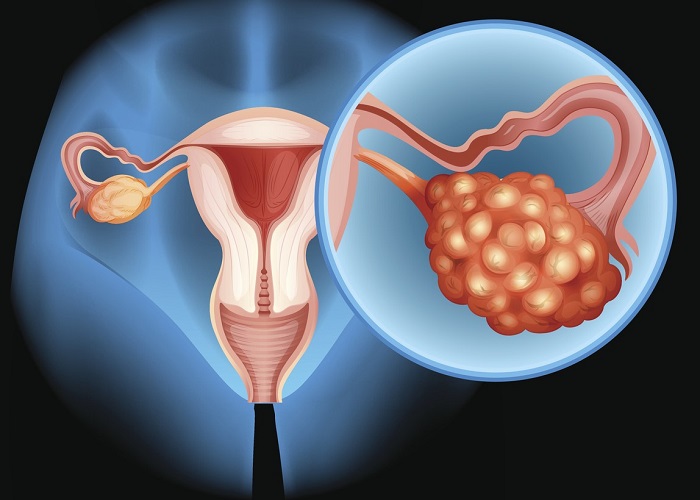
Experts say that removal of the fallopian tubes can reduce the risk of a woman getting ovarian cancer by 80% – and that most cases of ‘ovarian cancer’ actually involve the fallopian tubes. Few cases start in the ovaries, and those that do can mostly be cured, reports The New York Times.
Kira Wynn will do almost anything to avoid ovarian cancer, which killed her mother. As is often the case with ovarian cancer, Wynn’s mother’s disease was already at an advanced stage when she was diagnosed. She died 10 months later.
Genetic tests could not pinpoint a mutation that would reveal whether her daughter was at risk for ovarian cancer, too.
So Wynn (37), had a consultation with Dr Rebecca Stone, a gynaecological oncologist at Johns Hopkins Medicine. What she heard was not what she expected.
“Ovarian cancer,” Stone told her, is a misnomer. Nearly all ovarian cancers – and nearly all fatal ovarian cancers – are actually cancers of the fallopian tubes. The 20% or so that start in the ovaries are different, Stone said, and usually can be cured.
Women who have their tubes (the gummy worm-shaped ducts that carry eggs from the ovaries to the uterus) removed reduce their chances of getting ovarian cancer by nearly 80%. It’s a five-minute operation that can be done as part of nearly any abdominal surgery, including a hysterectomy, tubal ligation, gallbladder surgery and hernia repair.
Yet no doctor, Wynn said, had ever mentioned fallopian tube removal to her.
That’s not surprising, Stone said, because most doctors (and the public) do not know about this new approach, even though professional groups like the American Cancer Society, the American College of Surgeons and the European Society of Gynaecological Oncology have recently issued statements encouraging doctors to offer tube removal at the time of other abdominal surgeries.
The American Cancer Society is now working on a national campaign to make more women and doctors aware that tube removal can help prevent most ovarian cancers. The group plans to begin the campaign next year, said Anne Reynolds-Doerr, a spokeswoman.
Women have, on average, a 1.1% risk of being diagnosed with ovarian cancer, among the most deadly of all cancers. Screening to find it early does not work (death rates do not budge). Ultrasound, blood tests and advanced imaging have all failed. And most of the 20 000 women a year who receive a diagnosis of ovarian cancer have no known risk factors.
By the time they find out why they have vague symptoms like bloating and abdominal pain, the cancer has spread throughout their bodies. Surgery and chemotherapy – the standard treatments – are unlikely to cure them.
The tumours start as microscopic specks of cancer cells that spill out of the wide end of the fallopian tube that is nestled against an ovary. They seed the ovary and abdomen, where they grow and become lethal.
Dr Kara Long, an ovarian cancer specialist at Memorial Sloan Kettering Cancer Centre, likens these tiny cancer cells to dust coming up from a rug and floating through a room.
Stone says they’re like dandruff drifting down to a person’s shoulders.
That discovery, Long said, “was a lightbulb moment for us”. It explained why early diagnosis so often failed: those tiny cells do not show up on ultrasound or other imaging.
But the finding did not seem to penetrate the medical community. “How do you take a critical discovery, one of the most critical discoveries in my lifetime, and move it to standard of care?” Stone asked.
The first inkling that most ovarian cancer starts in the fallopian tubes began in 2000 with a Dutch PhD student, Jurgen Piek. He knew that women with certain mutations in either of two genes, BRCA1 or BRCA2, had a greatly increased risk of ovarian cancer. Many decide to have their ovaries removed preventively to protect themselves.
So Piek began studying the ovaries that the women chose to have removed, looking for early signs of cancer. Doctors who remove ovaries also remove fallopian tubes at the same time, because although ovaries can survive without the tubes, the tubes cannot survive without ovaries, which they rely on for their blood supply.
Piek noticed something that surprised him: He didn’t see any precancerous cells in the ovaries, but he often found them in the tubes. The cells looked just like early stage ovarian cancer.
In 2001, he postulated that ovarian cancer starts in the fallopian tubes. “I was at a few conferences at the time as a PhD student,” Piek said. Most attendees, he recalled, said “he’s a lunatic”. Others, he added, were intrigued.
Years of work followed.
“It took a lot of science for us to feel really confident about recommending that people remove a structure,” Long said. There were critical questions: were the tubes the source of cancer in women who had average risk? (The answer is yes.) Is it safe to remove tubes? (Yes.) Does the operation damage the ovaries? (No.)
Dr Joseph Sakran, a surgeon at Johns Hopkins Medicine, cautioned, though, that published articles were not enough to change practice. “There is a gap that exists between having the data out there and having it implemented,” he said.
Because removing the fallopian tubes affects fertility, doctors take care to explain the implications before offering the procedure. They want to tread carefully, making sure women don’t think they are being pushed into sterilisation. There’s a long history of forced sterilisation of disabled people, black people and disadvantaged people.
Now, Break Through Cancer, a foundation in Cambridge, Massachusetts, and the American Cancer Society, are conducting a study at Memorial Sloan Kettering, MD Anderson Cancer Centre and Johns Hopkins.
Every woman scheduled for abdominal surgery is offered a chance to see a video explaining what is known about ovarian cancer, and is then asked if she’d like her tubes removed during her surgery.
Any woman can decline to watch the video or decline to have her fallopian tubes removed, for instance if she is considering getting pregnant some day or just feels uncomfortable with the idea of having a healthy body part removed.
See more from MedicalBrief archives:
Fallopian tubes removal cuts ovarian cancer risk – Canada corroboration
Prevent ovarian cancer by removing fallopian tubes, urge experts
Annual screening for ovarian cancer does not save lives — Large UK trial