

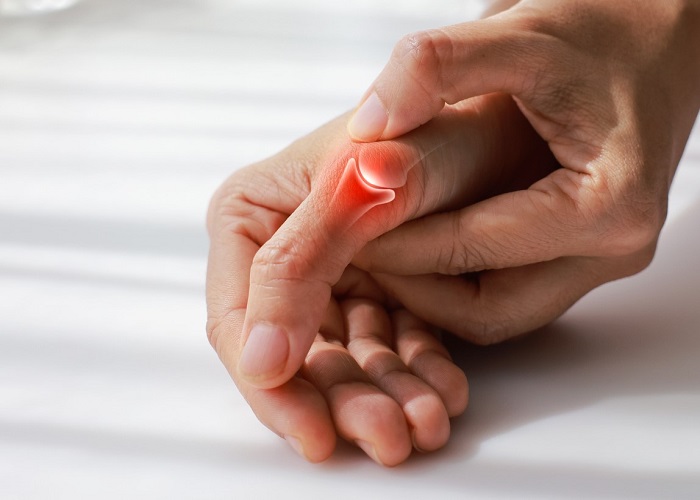
A nifty medical device that was recently approved by the FDA is offering hand surgeons an alternative way to fix thumb arthritis, which they say can reduce recovery time and improve function, reports The Washington Post.
Move your thumb around a bit. You’ll see that it can shift back and forth, side to side and in circles; that’s more than, say, your knee, which hinges just forward and backward.
This is thanks to the carpometacarpal (CMC) joint, at the base of your thumb, which moves in multiple directions. But over time, all of that movement can wear out the ligaments around the joint, making it shift and rub abnormally, said Ryan Schmucker, a hand surgeon at the Ohio State University Medical Centre.
“And that’s when you wear away your cartilage and get arthritis.”
For advanced arthritis, the most common treatment is a trapeziectomy. This involves removing the trapezium, a small bone at the base of your thumb, near your wrist. While it tends to be overall effective, it comes with some cons, too – which is where the new medical device comes in.
We talked to clinicians who are doing this procedure to understand why they’re excited about it.
How thumb arthritis surgery typically works
When cartilage is worn away, bones no longer have a cushion between them. By removing the trapezium, you eliminate the bone-on-bone contact. The remaining gap is either left to naturally fill with a cushion of scar tissue over time, or the surgeon will use a piece of tendon to help stabilise the space.
“If you looked at those patients who had this surgery, they did fine,” said Jonathan Tueting, a hand surgeon at Rush Medical Group in Illinois. “They had resolution of pain, and they were able to return to function. But if you were critically evaluating how they did, you would find that they did not have the same strength as the normal side.”
They also didn’t end up with the same thumb position that a normal thumb might have, he added. Additionally, the thumb can drop over time, making it less well positioned for pinching and gripping.
Recovery from a trapeziectomy is long, too: “We’re talking about cast immobilisation for six weeks, a removable splint for another six weeks with a lot of therapy, and then gradual return to function and strength,” Tueting said, noting that the thumb typically doesn’t feel close to normal for a year post-surgery.
New implant and surgical approach
Last year, the Food and Drug Administration approved a thumb implant called the KeriMedical Touch CMC 1 Prosthesis. This device allows for a procedure where the trapezium stays put, and the surgeon instead inserts the device into the centre of the bone. It has a ball-and-socket design that moves around.
“The biggest functional difference between this and trapeziectomy is that this preserves the thumb’s length, which aids in pinch and grip strength,” Schmucker said. “Imagine pinching against a thumb that’s cushioned by a pillow versus one that has stable metal implants.”
According to a randomised trial published in the journal Hand, people who had the implant recovered faster, gained range of motion quicker and stayed stronger through the study’s two-year follow-up compared with those who had a trapeziectomy.
“The recovery is light-years ahead of the original procedure,” said Karan Desai, a hand surgeon at Orlando Health Jewett Orthopaedic Institute and member of the American Society for Surgery of the Hand. “The majority of my patients are feeling normal at around six weeks.”
If you were to get this new surgery, you should still avoid intense gripping and pinching for a few weeks, “but patients feel so good that it’s hard to pull themselves back”, Schmucker said. “At six weeks, my first patient asked me if she could use her chainsaw again, and I said ‘No, please wait a little bit longer’.”
Surgeons have been doing this procedure in Europe for the past decade, and Tueting said the failure rate is “very, very low”, just 2% in one follow-up study, “which is perfectly in line with what we accept for total knee and total hip (replacement)”.
Now that the thumb implant has been approved by the FDA, there’s a lot of interest in the United States, but the rollout will be gradual since it’s a technical procedure and surgeons need to be trained to do it.
Roxanne Drake (71), a patient of Schmucker’s, had the surgery several months ago. She dealt with arthritis for years but avoided a trapeziectomy because of the long recovery.
“I live on a little farm by myself, and I can’t afford to pay people all the time to come out here,” Drake said. “But this turned out really, really well. I could move my thumb the very next day, and there’s hardly even a scar.” She’s scheduled to have the same surgery on her other hand within months.
Drawbacks to consider
Implants don’t last forever, and this device needs to be replaced every 10 to 15 years. “If you’re in your 40s or early 50s with early arthritis, surgery is the last option you want to pursue,” Schmucker said, noting that it’s best to reduce the number of surgeries you’ll have over your lifetime.
“Each time we operate, we add more scar burden to the same area and the outcomes are less likely to be positive,” he pointed out.
One Journal of Clinical Medicine study that included 200 Touch implants found that complications include loosening of the device’s cup and fracturing the trapezium during surgery, though serious issues were uncommon.
“Anatomy-wise, there are certain patients who won’t be good candidates based on what we see on the X-rays,” Desai said. “When people have extremely advanced disease, the bone will degrade and become really tiny or thin, and it won’t be able to support the implant.”
If you have arthritis in other joints nearby, this implant wouldn’t completely resolve your pain. In those cases, a trapezioectomy is still your best bet.
And while the implant can hold up to standard strength training, Desai said it might not be a fit if you do heavy labour, like construction work, for a living.
Non-surgical treatments for thumb arthritis
“There’re lots of good things that we can do at the outset to manage the arthritis,” Schmucker said. First, a glove-like sleeve that supports the joint and reduces inflammation. Then, physical therapy or topical anti-inflammatories.
“If all of those things are not working, then we move to steroid injections,” Schmucker said. “I have patients who come in once a year, they get their steroid injection, and they go on their way without pain for many months out of the year.”
He added that arthritis waxes and wanes, and patients’ best course of action depends on the severity of their symptoms.
“I tell patients, if you can do everything you want to do, even if it’s occasionally painful, you should continue to do that until you reach a point where you can’t do that anymore,” Schmucker said. “Then, once you can’t do that anymore, that’s when we start to think about surgery.”
See more from MedicalBrief archives:
Low-dose radiation re-emerging as osteoarthritis therapy
Osteoarthritis to affect 1bn people by 2050, predicts global study