


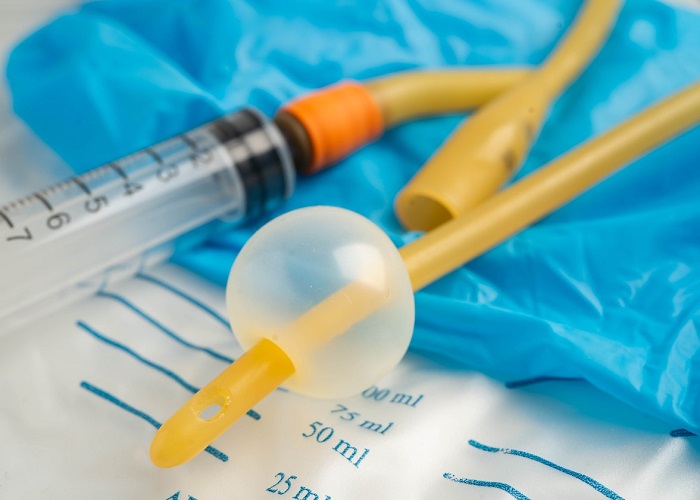
Reusable catheters could not only slash hospital costs but are just as safe for patients as single-use ones and don’t increase the risk of urinary tract infections, a British study has found.
Thousands of people use the devices to empty their bladders up to four times a day on average, and the plastic tubes are used just once before being discarded.
For their study, University of Southampton researchers followed hundreds of patients for a year to measure the health impact of reusable intermittent urinary catheters against single-use ones.
They discovered that those who tested reusable catheters used 35% fewer antibiotics than their single-use only counterparts.
The landmark study, published in the International Journal of Nursing Studies, was funded by the National Institute for Health and Care Research (NIHR).
Experts say the findings could save public health systems like the NHS millions and cut down on thousands of tonnes of plastic waste produced each year.
Lead author Professor Mandy Fader, in the school of Health Sciences at the University of Southampton, said: “Until now, there has been a real lack of high-quality evidence to support the reuse of catheters.
“But after our study, we can say for the first time that it is a safe option to switch to reusable catheters.”
For decades, patients in the UK have been strictly advised by healthcare professionals to use single-use catheters to prevent urinary tract infections (UTIs), leaving no choice for those wanting to use the more green-friendly reusable options.
The Southampton study followed 578 participants across a 12-month period, split into two groups – one of which stuck to single-use tubes.
The other group, however, used both the reusable and single-use catheters, and were given a kit to wash them in soap and water, followed by a soak in chlorine solution.
Scientists found 29% of those in the mixed-use group had at least one UTI during the year, compared with about 34% of those who used a fresh one each time.
Study co-author Margaret Macaulay, also from Southampton, said: “The NHS is full of single-use products, and many healthcare professionals caution against reusable items because of the risk of infection.
“However, our results clearly show that reusable catheters can and should be used by the NHS without increasing infection rates.
“People should have the choice to switch depending on their lifestyle needs – and cut down on the throwaway culture in our health service.”
According to the research team, around 100m single-use catheters are prescribed by the NHS across the UK every year.
They also found that cost of the single-use tubes to taxpayers has escalated from £22m in 1998 to around £200m in 2026.
“A box of 30 single-use catheters can cost about £50,” added Southampton Professor of Continence Cathy Murphy.
“Reusable catheters in our trial cost less than 10p per use and can be reused for a month. If just 25% of patients made the switch, the NHS could save millions.”
Study details
Mixed (reusable/single-use) catheter management versus single-use catheter management for intermittent catheter users (MultICath): A non-inferiority randomised controlled trial
Mandy Fader, Margaret Macaulay, Nina Wilson et al.
Published in International Journal of Nursing Studies in August 2026
Abstract
Purpose
To determine if reuse of intermittent catheters is safe for the community management of long-term bladder emptying problems, this trial compared using a combination of reusable and single-use catheters (Mixed-use), to standard practice of single-use catheters only and examined the incidence of urinary tract infections (UTI).
Design
Open label, randomised, non-inferiority trial.
Setting and participants
Community-dwelling intermittent catheter users aged over 18 were invited to join the Trial by 234 general practices and five community nursing teams across the United Kingdom. The Trial was managed from two university-based trial centres (Southampton and Glasgow) from April 2021 to July 2024.
Interventions
Random assignment (1:1) using permuted block sequences via a web-based system to receive either Mixed-use (trial reusable catheters plus participants' own single-use catheters) or Single-use (participants’ own single-use catheters) for 12 months. Treatment allocation was masked from microbiology assessors but not participants or researchers.
Main outcome measures
The primary outcome was at least one episode of microbiologically confirmed symptomatic UTI (any sign or symptom) with help-seeking or self-help over 12 months. The critical odds ratio for non-inferiority was 2·0. The primary analysis was on a per protocol basis. Secondary outcomes included antibiotic-use, quality of life and participant reported problems with catheterisation.
Results
578 participants were randomly assigned to Mixed-use (n = 289) or Single-use (n = 289). The per protocol analysis comprised 171 participants in Mixed-use and 244 participants in Single-use. The primary outcome of at least one UTI episode over 12 months was met by 49 (28·7%) of 171 participants in Mixed-use and 84 (34·4%) of 244 participants in Single-use. Mixed-use was non-inferior to Single-use (unadjusted odds ratio (95% CI): 0·77 (0·50, 1·17)). Antibiotic use was 35% less in Mixed-use compared to Single-use (adjusted incidence rate ratio (95% CI): 0·65 (0·45, 0·95)). Catheter ‘sticking’ was significantly worse in Mixed-use compared to Single-use. Participants reused a median of 2·8 (interquartile range: 1·8, 3·9) times per day. Quality of life and adverse events were similar across both groups.
Conclusions
For the community management of long-term bladder emptying problems, the combined use of reusable and single-use catheters is as safe as using only single-use catheters for UTI and is associated with lower antibiotic use. Reusable catheters can be offered as a safe choice for intermittent catheter users.
See more from MedicalBrief archives:
New guidelines on urinary catheter use
UCT call on SAHPRA to revisit single-use medical device ruling
Poor doctor-nurse communication behind most catheter use problems