


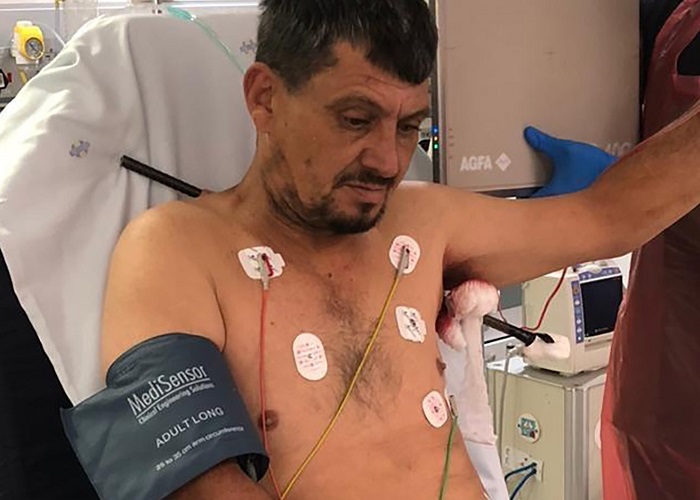
A complex trauma scenario was resolved with remarkable skill and precision recently at Netcare Christiaan Barnard Memorial Hospital, after a steel rod impaled a man who’d fallen off a ladder but who survived, thanks to valuable team work.
For vascular surgeon Dr Sanju Sobnach who received the emergency call, and who had relocated from Gauteng and joined the Level 1 Trauma Centre in Cape Town only a week earlier, the horrendously penetrating injury was a baptism of fire, reports MedicalBrief.
The injured man, assistant mechanic Theunis du Plessis, had been at work when the ladder he was standing on suddenly slipped, sending him crashing into a metal stand. A steel reinforcing rod protruding from the stand entered under his arm, passed through his chest and exited his opposite shoulder
Drawing on years of experience managing complex traumatic injuries, as well as previous research with Professor Andrew Nicol on the management of retained penetrating objects, Sobnach immediately told the rescue teams at the scene not to move, twist or attempt to remove the steel rod under any circumstances.
Panning inside the trauma unit was already well under way before the ambulance even reached the hospital, where Sobnach had gathered the team for a briefing.
“The injury is imposing,” he told them. “Do not let the enormity of the task distract you from the basics, or we will lose the patient.”
The simple instruction became the guiding principle for every decision that followed.
When he arrived, Du Plessis was calm, and able to open and close both hands when asked, providing immediate reassurance he had avoided devastating neurological injury. He said that when the paramedics had arrived, “they couldn’t believe I was still alive…they had to cut the rod to get me into the ambulance, but were incredibly careful not to move it”.
“I can remember the hissing sound from the hole in my chest.”
For the trauma team, the hissing sound was a constant reminder of how precarious the situation remained. Every slight movement allowed air to escape through the wounds, with Sobnach saying it was like listening to a slow puncture in a tyre.
Obtaining a CT angiogram required careful planning because the patient couldn’t lie flat inside the scanner, but the eventual results showed that although the rod had passed through his underarm and chest before exiting through the opposite upper shoulder, it had narrowly missed the major blood vessels.
Du Plessis was also a heavy smoker, which may have reduced the resilience of his lungs, while the steel rod itself was rusty, posing a significant risk of infection. Additionally, its ridged surface made removal considerably more difficult than it would have been with a smooth object.
Every decision mattered
In theatre, Sobnach and his team carefully exposed the injured areas before making another deliberate decision. Rather than removing the rod immediately, they waited to see whether a damaged blood vessel would begin to bleed, worried that it might have temporarily plugged the injured vessel, and that pulling it out too soon could have triggered catastrophic haemorrhage.
About 10 minutes later, slow bleeding began, exactly as anticipated, and only then did the surgeons slowly withdraw the rod in a perfectly straight line.
After surgery, Du Plessis spent a day in ICU before being transferred to a general ward the next day. Because of the condition of the steel rod, preventing infection became a major focus of his care, with tetanus prophylaxis, antibiotics and antifungal treatment forming part of his recovery. Five days later, he was discharged.
The real lesson
Sobnach says the outcome was never about one surgeon or one operation. “It began with rescue personnel and paramedics who understood the importance of keeping the rod completely still. It continued with careful planning before the patient arrived at the hospital, relying on specialists from multiple disciplines working together seamlessly, from the emergency department through to intensive care.
“In a case like this, every decision mattered, and every team member had a critical role to play when his life was in the balance.”
A week later Du Plessis returned to work, triumphantly arriving back at the workshop carrying the steel rod that had impaled him.
See more from MedicalBrief archives:
‘Miracle Man’ hands Comrades Marathon medal to trauma surgeon